Cart 0


mould outbreak was discovered at John Hunter Hospital’s Paediatric Outpatient Department in Newcastle, NSW — one of the state’s busiest centres for treating children with serious and complex conditions. Investigations revealed mould in eight of the hospital’s 12 clinic rooms, with two assessed as “significantly affected.” Most alarmingly, the contamination extended into the Paediatric Oncology Day Unit — a department caring for children undergoing cancer treatment, whose immune systems are among the most vulnerable of any patient group. Despite urgent remediation efforts, the mould returned. It was found again in a new area of the unit.
If a clinical environment — subject to rigorous hygiene protocols, professional maintenance teams, and institutional accountability — cannot permanently resolve a mould problem, it raises an uncomfortable question for the rest of us: if a hospital cannot break the cycle, what does that mean for our homes, our children’s bedrooms, and the spaces where we spend the majority of our lives?
The answer, it turns out, may lie not in how often we clean — but in how we clean, and more critically, what happens to the air in between. Conventional cleaning routines and standard passive air purifiers are designed to manage visible dirt and capture airborne particles that pass through a filter. But mould is not a surface problem. It is an airborne, structural, and environmental problem — one that passive approaches alone are increasingly proving insufficient to address.
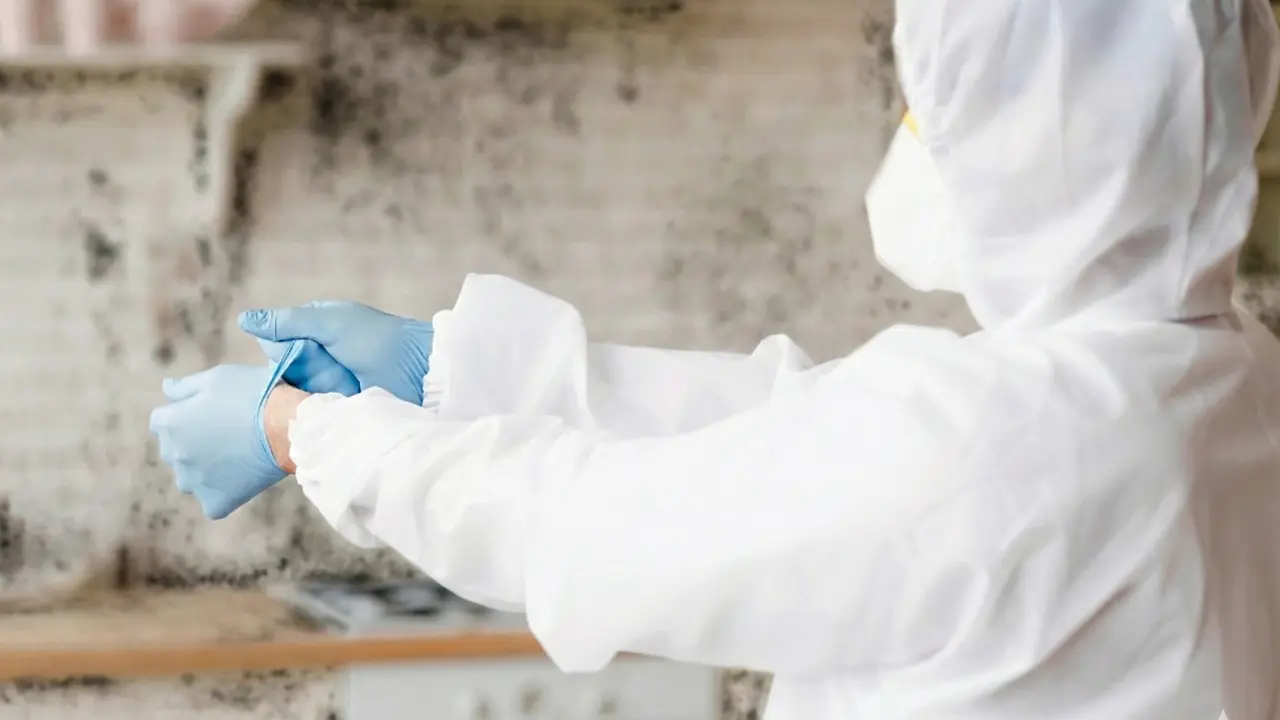
Mould is rarely just a cosmetic issue. What makes it particularly hazardous is the size of its reproductive particles known as spores which range between 2 and 10 microns in diameter. At that scale, spores are invisible to the naked eye, easily suspended in the air, and small enough to bypass the body’s upper respiratory defences entirely, travelling deep into the bronchioles and lung tissue. For healthy adults, repeated exposure may cause persistent irritation. Long-term exposure to these inhaled spores can lead to a condition known as Mould Sickness, which directly impacts the immune and respiratory systems. For higher-risk groups — young children, elderly individuals, cancer patients, and anyone with a compromised immune system — the consequences can be significantly more serious.
Prolonged or repeated exposure to airborne mould spores is clinically associated with a range of respiratory and immune conditions, including chronic sinusitis, asthma exacerbation, allergic rhinitis, and in severe cases, hypersensitivity pneumonitis — an inflammatory lung condition triggered by inhaled biological particles. These are not theoretical risks. At John Hunter Hospital, a staff member directly warned that infants in the affected unit could be exposed to mould spores and face physical harm — including the risk of a ceiling tile collapsing. That warning came from within a regulated medical facility, not a neglected building.
Warm, humid conditions are all mould needs to thrive — and once established, it does not simply disappear with the season. At John Hunter Hospital, the first outbreak was recorded in February, yet the problem returned the following summer, and the one after that. Heat and humidity do not just encourage mould growth; they sustain the cycle that makes it so difficult to break. Which raises a critical question: if the environment keeps enabling it, why does conventional cleaning keep failing to stop it?
According to the report, although the roof panels were replaced, the ventilation system was cleaned, and the air conditioning filters were serviced, the remediation process was considered thorough by conventional standards. Nevertheless, the mould returned once again, prompting an urgent, state-wide review of healthcare facilities across New South Wales.
This demonstrates that reactive measures alone are not sufficient to fully resolve a problem that persists in areas that are difficult to access.
The recurring failure points to three structural limitations that standard cleaning and passive filtration cannot overcome:
Passive Air Purifier | Active Vapour Technology | |
Mechanism | Waits for air to pass through the filter | Releases active molecules into the environment |
Surface coverage | No — filter only | Yes — reaches surfaces directly |
Dead zone protection | No air movement = no filtration | Vapour disperses regardless of airflow |
Inside ducts & cavities | Inaccessible | Penetrates hard-to-reach areas |
Humid conditions | Reduced effectiveness | Effective in high-humidity environments |
Ongoing protection | Reactive — captures existing particles | Proactive — continuously treats the space |
Passive systems are designed to filter the air that comes to them — but mould does not wait, and neither should your solution. Air purifier for mould with Active Vapour Technology works the way effective protection should: continuously, proactively, and across every part of the space — not just the air directly in front of a filter.
The distinction between passive and active air purification is not a matter of marketing — it is a matter of mechanism. Passive purifiers are stationary by design: they draw air in, filter it, and release it. Their effectiveness is entirely dependent on air travelling through the unit. Active purification works on an opposing principle.
Rather than waiting for contaminated air to arrive, an active system dispatches purifying agents directly into the environment — reaching surfaces, corners, cavities, and spaces that airflow never touches. VBreathe’s Enviroguard pro™ x unit achieves this through purox™ gel, a proprietary active compound that continuously generates and releases purifying vapour molecules into the surrounding space. It is the difference between placing a net in a river and treating the water at its source.
Mould rarely announces itself. By the time it becomes visible, it has typically been present — and releasing spores — for weeks or longer. These are the five indicators that warrant immediate attention:
Standard cleaning routines address visible surfaces. Mould does not limit itself to visible surfaces. The following locations are consistently overlooked — and consistently problematic:
Q: Can mould spores survive in an air-conditioned room?
Yes. Air conditioning reduces temperature but does not eliminate humidity at the source. Ducts and filters can harbour spores and redistribute them throughout the space with every cycle.
Q: Does a HEPA filter remove mould from the air?
Partially. A HEPA filter can capture spores that pass through the unit, but it has no effect on spores already settled on surfaces, embedded in materials, or present in areas with poor air circulation.
Q: How quickly can mould grow indoors?
Under the right conditions — humidity above 60% and a temperature above 20°C — mould can begin to establish on surfaces within 24 to 48 hours of moisture exposure.
Q: Is mould dangerous even if I cannot see it?
Yes. Invisible mould colonies within walls, ducts, and ceiling cavities release spores continuously into the air you breathe. The absence of visible growth does not indicate the absence of risk.
Q: How is active vapour different from an air freshener or spray disinfectant?
Sprays and fresheners are single-application products — they treat a surface or mask an odour at a specific moment. Active vapour technology such as VBreathe’s purox™ gel operates continuously, dispersing purifying molecules throughout the space on an ongoing basis rather than offering a one-time fix.
The situation at John Hunter Hospital is a clear illustration of what happens when the response to mould is consistently reactive. Panels were replaced. Filters were cleaned. The mould returned. Not because the effort was insufficient — but because the approach was fundamentally limited by design.
The same limitation applies in any indoor environment. Conventional cleaning and passive filtration manage the problem after it has already taken hold. They do not prevent it from establishing in the first place, and they cannot reach the places where it persists between outbreaks.
Protecting the air quality of your home — particularly if children, elderly individuals, or anyone with a respiratory condition lives there — requires a solution that works continuously and proactively. One that does not wait for spores to come to it. One that, much like sunlight in an open environment, reaches every surface, every corner, and every breath of air in the space.
Remove
Total Amount
Adding {{itemName}} to cart
Added {{itemName}} to cart