A Comprehensive Pet Air Quality Guide
For pet owners, home hygiene presents challenges that are far more complex than they appear. While many believe that managing visible “pet hair” on floors or furniture is the primary task, indoor air quality (IAQ) experts know that the greatest threat to occupant health is often invisible.
These pollutants are known as Bio-aerosols. They consist of microscopic protein particles, bacteria, saliva droplets, and VOCs continuously released by pets. Traditional cleaning methods, such as vacuuming or using standard air fresheners, often only address the symptoms. In some cases, they even leave behind residues that are harmful to the sensitive respiratory systems of both pets and humans.
This guide explores the science behind these pollutants and provides a systematic, international-standard approach to air management. Our goal is to shift the focus from surface cleaning to sustainable environmental wellness for the long term.
Why Regular Cleaning Falls Short
A common misconception in managing pet pollution is that allergens simply settle on the floor like heavy dust. In reality, primary allergens—specifically saliva proteins and pet dander—are far more difficult to eliminate for the following reasons:
- Microscopic Size and Long Suspension
Most allergens are smaller than 2.5 microns (PM2.5), with some as small as 0.3 microns. Being extremely light, they can remain suspended in the air for several hours, even in seemingly still rooms. This allows them to enter the “breathing zone” of both humans and animals directly, a challenge that traditional sweeping or vacuuming cannot solve. - High Sticky Properties
Pet allergens (especially from cats) are remarkably sticky. They cling firmly to walls, curtains, upholstered furniture, and clothing. This turns various surfaces into “Pollutant Reservoirs” that continuously release allergens back into the air, even immediately after the floors have been cleaned. - Recirculation Loops
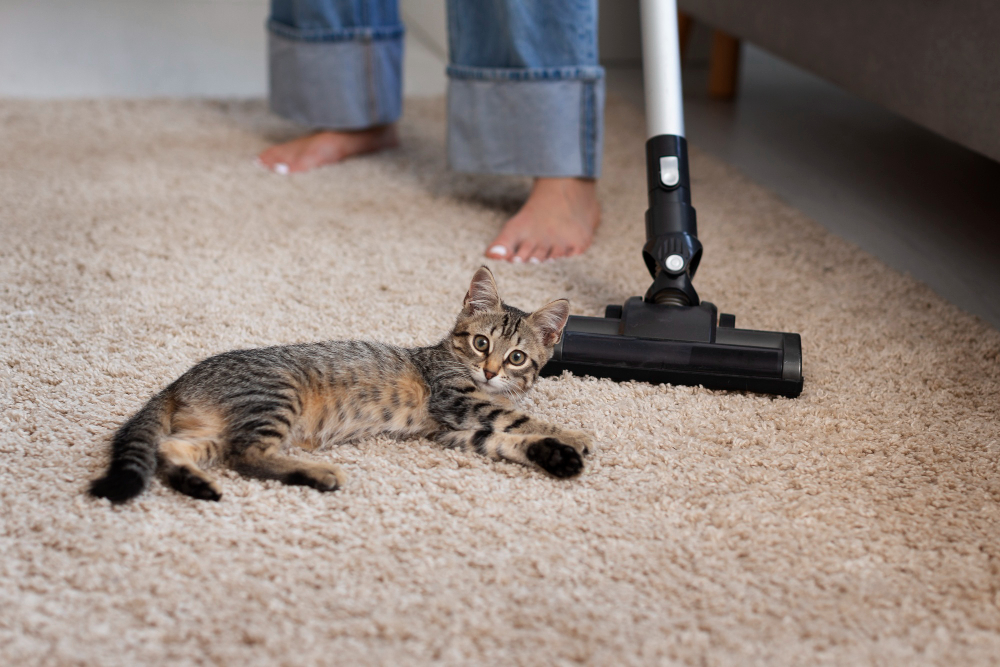
Standard cleaning, such as vacuuming, often creates a recirculation effect. The exhaust air from many vacuums can kick settled particles back into the air before they can be fully captured, failing to eliminate the problem entirely.
Research in aerobiology indicates that the primary cat allergen (Fel d 1) is exceptionally resilient. Significant concentrations can remain in a home for up to six months after a pet has moved out. This is due to the microscopic particle size and its ability to embed deeply into porous surfaces. (Source: Journal of Allergy and Clinical Immunology)
Respiratory Safety: Protecting Pets and People
Many pet owners use air fresheners, scented candles, or essential oils to mask unpleasant pet odours. However, this is merely “masking” the problem. Most of these products contain Volatile Organic Compounds (VOCs) and Phthalates, which directly affect respiratory systems. Pets are far more sensitive than humans: for instance, cats have limited detoxification systems, and birds possess air sacs that absorb airborne toxins much faster and more intensely than human lungs. Continuous exposure to these chemicals can lead to chronic respiratory inflammation and worsen allergy symptoms for everyone in the home.
A superior alternative is the use of Enzymatic Cleaners. These work by “biologically breaking down” the molecular structure of organic matter, such as ammonia from urine or proteins from saliva, eliminating the root cause of the odour permanently. Furthermore, choosing air management solutions that meet high safety standards and are Ozone-free is essential. This ensures that sanitisation or odour removal does not harm the delicate lungs of pets, especially in enclosed environments with limited ventilation.
The Implementation Framework for Better Health
Achieving professional-grade air quality in a pet-friendly home requires a holistic strategy that manages everything from the source to the lingering airborne pollutants:
- Source Control
Reduce the volume of allergens directly from the pet. Brush your pet daily to remove dander and loose hair before it becomes airborne. Bathe them every 4–6 weeks using a mild shampoo and maintain a high-quality diet to improve skin health and reduce dander shedding. - Surface Hygiene
Vacuum at least twice weekly using a machine equipped with a HEPA filter to capture microscopic particles from floors and carpets. Wash pet bedding and toys regularly in hot water to break down protein residues and reduce bacterial buildup. - Environmental Control
Maintain relative humidity between 40% and 50% to reduce the buoyancy of allergens and prevent mould growth. Additionally, monitor the outdoor Air Quality Index (AQI). If it exceeds 100–150, keep windows closed to prevent outdoor pollutants from adding to the indoor bio-load. - Advanced Air Treatment
When physical cleaning cannot reach microscopic airborne particles or “dead zones” (areas with no airflow), use Vapour Phase Oxidation Technology. It disperses through the air to break down the structure of allergens and pathogens on both surfaces and in the air, helping to close the gaps that traditional filtration cannot address.
Moving Beyond Passive Filtration
Modern air purification solutions are divided into two categories: “Passive” (trapping pollutants that pass through a machine) and “Active” (proactively targeting pollutants at the source). While high-efficiency filters are a good foundation, homes with a high Bio-load from pets require more than just one system to ensure no area is left untreated.
Technical Comparison Table
| Technical Factor | Passive Filtration (Mechanical HEPA & Carbon) | Active Treatment ( Vapour Phase Oxidation technology ) |
| Mechanism | Passive: Air must pass through the filter to trap particles and absorb odours. | Active: Disperses natural vapours to neutralise the structure of pollutants. |
| Reach | Limited to the area near the device. Corner “dead zones” are often missed. | Covers the entire room through molecular diffusion, even in stagnant areas. |
| Surface Management | Cannot address allergens or pathogens clinging to carpets or furniture. | Vapour penetrates fabrics and surfaces to break down allergenic proteins. |
| Sustainability | Pathogens can accumulate and grow on the filter (Filter Contamination). | Continuously reduces the accumulation of pathogens and allergens in the environment. |
The current gold standard in IAQ (Indoor Air Quality) technology is the “Active Approach” approach. This combines a HEPA filter to trap pollen and fine dust with an Vapour Phase Oxidation Technology to neutralise sticky proteins like Fel d 1 and bacteria in hard-to-reach areas. This combination reduces airborne pollutants faster and significantly lowers the “surface load” of allergens, which is the primary cause of chronic allergies.
Technical Verification & Case Study
Academic field tests have confirmed the efficacy of Vapour Phase Oxidation technology in significantly reducing allergens and pathogens on both surfaces and in the air. This proactive approach outperforms passive filtration alone. For a deeper look into the mechanisms and verified results, please refer to the full technical document: EnviroGuard Case Study (V12). This serves as a professional reference for achieving hospital-grade air standards in residential settings.
Conclusion
Understanding and systematically managing airborne pollutants is the key to closing the safety gap left by traditional cleaning. Moving from Passive filtration to Active management ensures the highest level of wellness for both owners and pets with sensitive respiratory systems.
Based on international safety and IAQ standards, the VBreathe EnviroGuard PRO™ X is designed to meet these requirements. Its Vapour Phase Oxidation technology works in an integrated system with the filter, while the Purox™ Gel releases hydrogen peroxide that disperses throughout the room. This helps neutralise up to 99.9% of allergenic proteins, bacteria, and mould on both surfaces and in the air.
Most importantly, VBreathe is committed to the highest safety standards. Our Food-grade ingredients are free from harmful chemicals and ozone. This gives you the confidence that your Hospital-grade clean air is truly safe for children, infants, and pets. Choosing a data-driven, proactive solution is a vital investment in the long-term safety and freshness of your home.
FAQs (Frequently Asked Questions)
1. How can I improve indoor air quality in a home with multiple pets?
Use a combined strategy: run a HEPA air purifier, vacuum with a HEPA machine at least twice a week, brush pets daily, and keep humidity at 40–50% to prevent allergens from floating.
2. Can a standard air purifier truly eliminate pet odours?
It helps, but only for the air that passes through the filter. For odours trapped in furniture and fabrics, an Vapour Phase Oxidation Technology is recommended, as it neutralises odour molecules directly at the source.
3. Are air fresheners safe for my pet’s respiratory system?
Most contain VOCs that irritate pet lungs (especially cats and birds). Avoid chemical masking sprays and choose products labelled as Non-toxic or Food-grade for maximum safety.
4. Why do pet allergies often feel worse at night?
Microscopic dander is light and settles easily on bedding in still air. Using an active air management system in the bedroom helps neutralise these triggers mid-air before you breathe them in.
5. How often should I clean to control pet dander?
Vacuum twice a week and wash pet bedding weekly. However, since dander (PM2.5) can stay airborne for hours, continuous air purification is necessary to prevent daily pollutant buildup.