VOCs and Formaldehyde | Do You Need a Special Air Purifier?
If you have recently purchased an air purifier labelled “VOC removal” for your home and feel that the air quality has improved, that might be true—but it is likely not the whole story. VOCs and formaldehyde are often discussed together, leading most people to assume they are the same […]
Air is clean and safe. No health risks expected. Everyone can enjoy outdoor activities without concern.
PM₂.₅
1.93
PM₁₀
2.93
SO₂
3.15
NO₂
8.87
O₃
57.97
CO
139.91
Table of Contents
Share
Today’s Air Quality
London, GB
1:51 PM
Air QualityGood
Air is clean and safe. No health risks expected. Everyone can enjoy outdoor activities without concern.
PM₂.₅
1.93
PM₁₀
2.93
SO₂
3.15
NO₂
8.87
O₃
57.97
CO
139.91
If you have recently purchased an air purifier labelled “VOC removal” for your home and feel that the air quality has improved, that might be true—but it is likely not the whole story. VOCs and formaldehyde are often discussed together, leading most people to assume they are the same thing and that a device capable of removing VOCs can naturally remove formaldehyde. Scientifically, however, they exhibit different chemical behaviours, originate from different sources, and, most importantly, require entirely different management mechanisms.
According to data from the World Health Organization (WHO) and the U.S. Environmental Protection Agency (EPA), formaldehyde is classified as a known human carcinogen. It is commonly found in building materials, plywood, adhesives, surface coatings, and even household cleaning products.
What most people do not realise is that some air purifiers tested for VOC removal under international standards may have never been tested directly against formaldehyde. This article will break down the true differences between the two and guide you in choosing the right technology for your living environment.
Formaldehyde vs. VOCs: Are They Even the Same Problem?
The short answer is: Formaldehyde is a VOC, but not all VOCs are formaldehyde.
This distinction is more important than it seems. VOCs, or Volatile Organic Compounds, are a broad group of chemicals that vaporise into gases at room temperature. The category covers hundreds of substances, ranging from benzene and toluene in house paint to xylene in varnishes and limonene in lemon-scented cleaning agents. Formaldehyde is one of these, but it has the lowest molecular weight (30.03 g/mol), moves the fastest, and poses the greatest danger at the lowest concentrations.
The WHO sets the indoor air quality guideline for formaldehyde at 0.1 mg/m³ (30-minute average), which is significantly lower than the thresholds for many other VOCs. This means formaldehyde is dangerous in much smaller quantities and is also harder to detect.
The Sources You Probably Have at Home Right Now
When formaldehyde is mentioned, people usually think of new furniture or fresh paint. While correct, this overlooks several hidden sources in a typical home. They can be categorised by their emission levels:
High Emitters (High-volume sources):
Plywood and MDF (Medium-Density Fibreboard) used for cabinets, shelving, and laminate flooring—especially those manufactured with urea-formaldehyde resin glues.
Spray foam insulation and certain types of thermal insulation.
Adhesives used for carpets, wallpaper, and flooring.
Low-to-Moderate Emitters (Unexpected sources):
Clothing treated with “wrinkle-resistant” or “no-iron” finishes, which use formaldehyde resins in the fabric treatment process.
Tissues and certain paper products.
Curtains and home textiles treated with fire-retardant coatings.
Cleaning liquids and personal care products containing formaldehyde-releasing preservatives, such as DMDM hydantoin.
Complicating matters further is that these sources do not simply release the chemical once and stop. A process called continuous off-gassing can last for months or even years, particularly in MDF and pressed-wood materials, which the EPA identifies as one of the primary sources of formaldehyde in residential buildings.
Why Formaldehyde Is Classified Differently from Other VOCs
Not all VOCs carry the same level of risk, and formaldehyde is categorised separately for a very clear reason. The International Agency for Research on Cancer (IARC) places formaldehyde in Group 1: Known Human Carcinogen. This means there is sufficient evidence from human studies that it causes cancer, particularly nasopharyngeal cancer (cancer of the upper part of the throat behind the nose), and it is linked to leukaemia from long-term exposure. In contrast, most typical VOCs, like toluene or xylene, are in Group 3 or are still undergoing evaluation.
Health impacts occur in stages:
At 0.1 ppm: Irritation of the eyes, nose, and throat (the threshold used for WHO guidelines).
Long-term, low-level exposure: Linked to an increased risk of cancer over time.
The reason formaldehyde must be treated differently from general VOCs when choosing an air purifier comes down to this incredibly low threshold. A device that “passes VOC testing” but is not specifically tested against formaldehyde cannot guarantee it will manage the chemical down to safe WHO guideline levels.
Why Does the Size of the Molecule Actually Matter?
When selecting an air purifier, most people look primarily at the CADR rating and HEPA certification. This makes sense if the target is PM2.5 dust and airborne particles. However, if the goal is to remove formaldehyde and VOCs, those numbers mean very little. The issue is not the machine’s efficiency, but the fundamental nature of what you are trying to filter. Air pollution falls into two completely different categories:
Particles: PM2.5, pollen, bacteria, and mould. These have mass, physical structure, and are large enough to be physically trapped by a filter.
Gas-phase molecules: Formaldehyde and VOCs exist in this realm. They have no tangible mass or physical structure that can be filtered out; they disperse freely in the air at a sub-nanometre level.
Standard HEPA filters are designed to achieve maximum efficiency at capturing particles measuring 0.3 microns (or 300 nanometres). However, a formaldehyde molecule measures just 0.37 nanometres. These two figures are in the same unit of measurement, but formaldehyde is nearly 800 times smaller.
To put this into perspective: if the gaps in a HEPA filter were the size of a front door, a formaldehyde molecule would be smaller than the thinnest coin. It does not “slip through” the filter; it was never blocked in the first place. This is not a flaw in HEPA technology, as it was designed for a completely different job. However, advertising a HEPA device as an “all-in-one” air purifier is scientifically incomplete.
If HEPA Can’t Catch It, What Can?
Understanding the limitations of traditional air filters leads to the next question: What can actually handle VOCs or formaldehyde at the molecular level? There are two main mechanisms:
Adsorption: Materials like activated carbon or zeolite draw gas molecules into their porous structures, removing them from the air. However, the gas is not destroyed; it is merely temporarily trapped. There is a risk of these gases being released back into the room when the filter becomes saturated or when temperatures fluctuate.
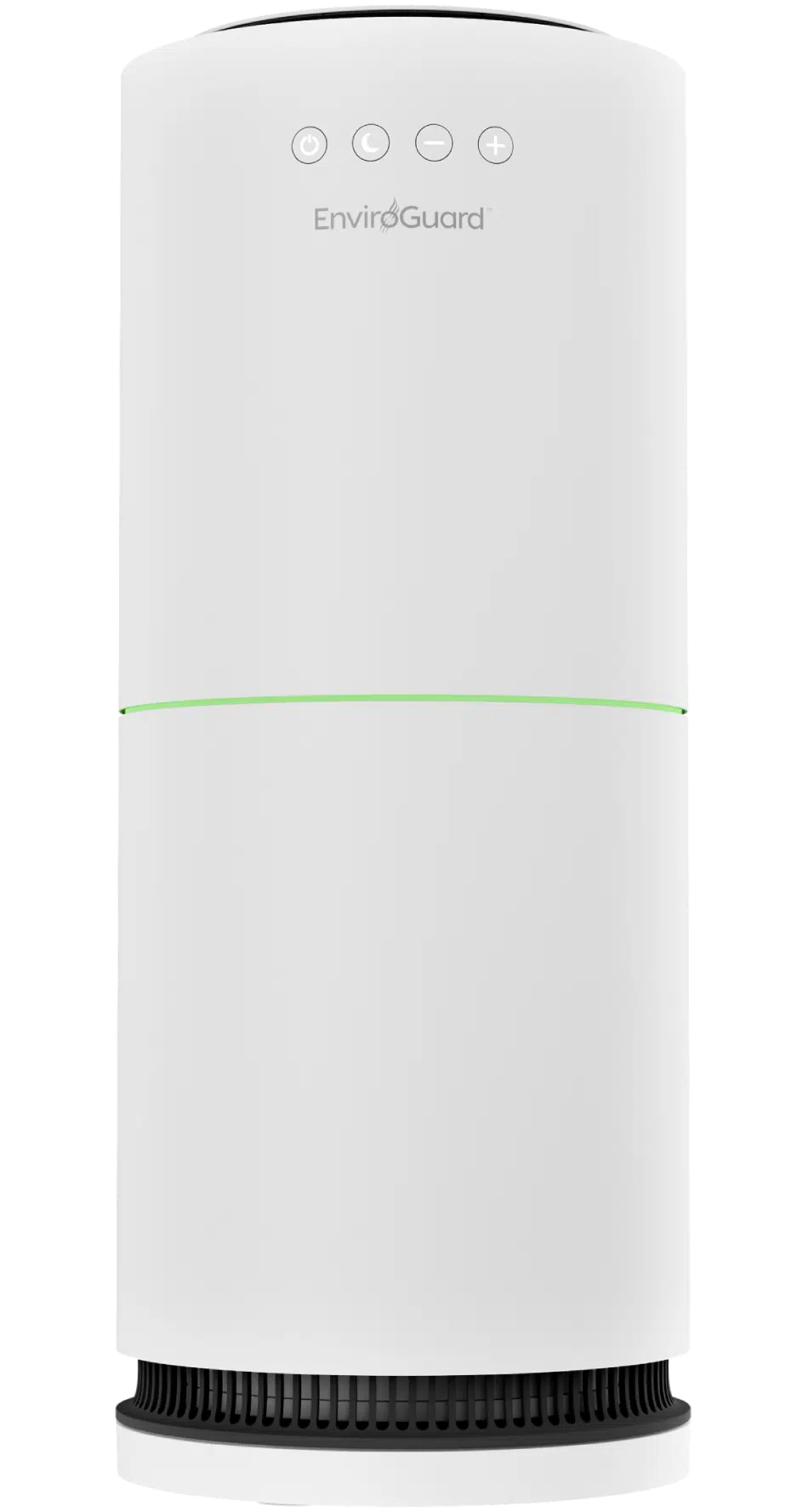
Oxidative Breakdown: Instead of simply trapping the molecules, technologies like Vapour Phase Oxidation (VPO) used in the EnviroGuard Pro™ X work by releasing hydrogen peroxide vapour (H₂O₂) at safe, low levels to trigger an oxidation reaction at the molecular level. The result is that formaldehyde and VOCs are transformed into water (H₂O) and oxygen (O₂), which are naturally safe. This actually destroys the pollutants rather than just relocating them to a filter.
This difference is not simply a marketing claim of “better” or “worse,” but a fundamental mechanical difference that impacts long-term safety, especially in spaces with continuous gas emissions.
How Long Does Formaldehyde Actually Stay in Your Home?
One of the most common misconceptions about formaldehyde is the belief that leaving the windows open for a few days will clear the smell and solve the problem. However, the absence of a smell does not mean the formaldehyde is gone. The human nose can detect formaldehyde at roughly 0.5–1.0 ppm—levels well above what is considered safe. By the time you can no longer smell it, formaldehyde may still be present at levels high enough to impact your health.
The Off-Gassing Timeline: Days, Months, or Years?
The rate of formaldehyde emission depends on the material, the quantity used, and the environment. The EPA and indoor air quality studies provide estimated timelines to help with planning, categorized by source material:
Off-Gassing Duration by Material
Material
Estimated Off-Gassing Duration
Accelerating / Extending Factors
MDF / Pressed Wood / Plywood
2–3 Years
Temperature, humidity, ventilation
Laminate Flooring & Veneers
1–2 Years
Thickness of the coating/finish
Wall Paint (Water-based)
2–3 Months
Room temperature, ventilation
Glues & Adhesives
3–6 Months
Type of adhesive, surface area used
Carpets & Home Textiles
6–12 Months
Accumulated moisture in fabrics
No-iron / Wrinkle-resistant Clothing
Decreases after several washes
Washing temperature
What makes these figures concerning in a real-world living context is that multiple sources often exist in the same space. A bedroom with laminate flooring, an MDF wardrobe, and new curtains may experience accumulated off-gassing from multiple sources simultaneously. This phenomenon is known as additive exposure and is a primary reason why indoor formaldehyde or VOC levels can be 2 to 5 times higher than outdoors.
Why Heat Makes It Worse
Temperature is a variable that directly affects the off-gassing rate of formaldehyde. Building science research indicates that for every 10°C increase in temperature, the evaporation rate of formaldehyde from materials rises significantly.
In tropical countries and northern Australia—where the average temperature is 28–35°C year-round, and areas like Queensland or the Northern Territory can soar to 38–42°C during summer—materials emit formaldehyde at a consistently higher rate than in cooler climates.
Even in cities like Sydney or Melbourne, where summer temperatures reach 30–40°C, homes are largely designed for natural light and ventilation. However, when houses are sealed up to run the air conditioning, the off-gassing conditions mimic those of the tropics. Furthermore, lifestyle habits in hot climates create an even more complex scenario:
The Typical Household Cycle in Hot Climates:
Close doors/windows to turn on the AC → The air recirculates with no fresh outdoor air to dilute it → Formaldehyde from materials steadily accumulates.
Leave for work and turn off the AC → Room temperatures spike → Off-gassing rate accelerates again.
Return home and turn on the AC → You breathe in highly concentrated formaldehyde right from the start.
In Australia, specific building trends exacerbate the issue: the widespread use of engineered timber, laminated flooring, and flat-pack MDF furniture—all high-emitters of formaldehyde. Combined with high external temperatures, these materials off-gas much faster than they do in standard manufacturer testing environments (typically 23°C and 50% relative humidity under ISO test conditions).
In this context, air purifiers relying solely on passive filtration are forced to work much harder than they were designed to. Meanwhile, active formaldehyde-management technologies, like the Vapour Phase Oxidation (VPO) in the EnviroGuard Pro™ X, are explicitly designed to handle non-stop, continuous off-gassing—not just the initial peak concentration.
Passive Filtration vs. Active Approach: Which One Actually Reaches the Formaldehyde?
Most air purifiers on the market operate the same way: they draw air in → push it through a filter → release cleaner air. This system works exceptionally well for dust and particles, but it has a major structural flaw when dealing with formaldehyde and VOCs. The pollutant must travel to the machine; the machine does not go out to handle the pollutant.
In a real living space, formaldehyde doesn’t just float in the middle of the room waiting to be sucked up. It clings to surfaces, seeps into materials, and slowly emanates from walls, floors, and furniture in every direction—including dead zones that the airflow of an air purifier simply cannot reach.
What Happens to Carbon Filters in High-Humidity Environments?
Activated carbon operates on the principle of physical adsorption. Gas molecules are attracted and stick to the porous structure of the carbon via Van der Waals forces. In a highly controlled laboratory setting, this mechanism is very efficient. However, in real-world high-humidity environments—such as the tropics or Australia during the wet season—a problem arises: water molecules compete with formaldehyde for space on the carbon’s surface.
Carbon does not exclusively target formaldehyde or VOCs; it grabs whatever comes its way. In air with 70–80% humidity (common in these regions), water molecules will monopolise the adsorption space, causing the actual capacity of the filter to drop significantly below its stated specifications.
Indoor air quality research suggests that the efficiency of an activated carbon filter in a high-humidity environment can drop by 30–50% compared to standard test conditions. This means the actual lifespan of your filter could be substantially shorter than what is printed on the box.
The Re-emission Problem — When Your Filter Becomes a Source
This is a scenario most air purifier manufacturers omit from their marketing materials.
When activated carbon becomes saturated—which can happen sooner than expected in environments with high formaldehyde and high humidity—the filter doesn’t just “stop working.” Under certain conditions, it can release the absorbed gases back into the air.
Conditions that trigger re-emission include:
Sudden temperature spikes: Leaving the AC off during a scorching hot day, then turning it back on in the evening. The period where the room temperature spikes before the AC cools it down is when carbon is most likely to release accumulated gases.
Sudden humidity drops: Turning the AC on blast in a highly humid room changes the adsorption equilibrium rapidly, potentially releasing trapped molecules.
Using filters past their lifespan: In high-risk areas, like newly renovated homes, the recommended replacement timeframe on the box may not reflect reality.
The fundamental difference with Vapour Phase Oxidation (VPO) in this context is its entirely different working mechanism. Instead of trapping formaldehyde in a filter, the VPO system in the EnviroGuard Pro™ X releases Purox™ Gel (a safe, low-level hydrogen peroxide vapour) throughout the entire room. This triggers a molecular breakdown at the chemical bond level. Formaldehyde and VOCs are broken down into H₂O and O₂. There is no accumulation in a filter, and therefore, no risk of re-emission.
Whatever clings to the walls or seeps into materials is neutralised right there on the spot. It doesn’t have to wait to float into the machine.
Technology Comparison
Feature
Activated Carbon (Passive)
VPO / Purox™ Gel (Active)
Reaches dead zones / corners
✗ No
✓ Yes
Efficiency drops in high humidity
✓ Yes(Significantly)
✗ No(Unaffected)
Risk of re-emission
✓ Yes(When saturated)
✗ No
Actually destroys molecules
✗ No(Traps only)
✓ Yes(→ H₂O + O₂)
Safety standards
—
100% Ozone Free
The Renovation Window — 24 Months That Matter Most
The 24 months following a home renovation or the introduction of new furniture is the period of peak off-gassing. Materials like MDF, pressed wood, and laminate floors release formaldehyde at their highest rates initially, gradually tapering off over time. During this phase, passive filtration systems face two clear limitations: the air must physically pass through the machine to be cleaned, and the carbon filter may saturate much faster than normal due to the continuous high gas emissions.
VPO is designed to sustainably manage these specific environments:
Newly decorated homes or apartments, especially enclosed spaces with built-in MDF wardrobes, shelving, and laminate flooring.
Nurseries or children’s rooms with new furniture (children are identified by the WHO as a higher-risk group due to their higher breathing rate relative to body weight).
Spaces with poor natural ventilation, such as high-rise apartments where windows cannot be opened, or places where the AC must run constantly due to extreme outside temperatures.
Additional Factor: Residues and Surface Pathogens In spaces where indoor smoking has occurred, residues like NNA and NNK from third-hand smoke embed deeply into surfaces and continue to off-gas long after the smoking has stopped. Passive filtration cannot reach these pollutants. However, the molecular breakdown mechanism of Purox™ Gel neutralises them directly at the chemical bond level. This active vapour mechanism also neutralises Staphylococcus aureus and other potential pathogens contaminating the space.
Which Technology Is Right for Your Situation?
Situation Effectiveness
Situation
HEPA Only
HEPA + Carbon
VPO Active (EnviroGuard Pro™ X)
Newly renovated home/condo (<24 months)
✗
△Limited
✓
New MDF / Pressed Wood furniture
✗
△Limited
✓
Nursery or high-risk group spaces
✗
△
✓
General PM2.5 dust
✓
✓
✓
Enclosed spaces with poor ventilation
✗
△
✓
Clinics / Offices post-renovation
✗
△
✓
Third-hand Smoke (NNA/NNK) residue
✗
✗
✓
High humidity (Tropics / Australia)
△
△Greatly reduced
✓
Safety standard for clinical settings
—
—
✓100% Ozone Free
(△ = Partially effective, heavily dependent on the amount of filter media and frequency of filter replacement)
Conclusion – So Does VOC Removal Mean Formaldehyde Removal?
Returning to the original question: Does an air purifier labelled for VOC removal also remove formaldehyde? The most direct answer is: Not always, and it depends on two major factors.
The mechanism used: Adsorption (trapping) and oxidative breakdown (destroying) yield entirely different long-term results. Machines relying solely on activated carbon temporarily hoard the formaldehyde, whereas VPO permanently breaks chemical bonds, converting it into H₂O and O₂.
The real-world environment: Filter performance in a laboratory at 23°C and 50% humidity does not equate to performance in a home at 35°C and 75% humidity in the tropics or an Australian summer. Real-world conditions simultaneously slash a filter’s adsorption capacity while aggressively accelerating off-gassing.
Data from the Cairns Case Study, conducted under ANSI IICRC S520 standards, demonstrates practically that the active vapour mechanism is more than just theory. In post-remediation testing, over 25 air samples all registered below 1 mould spore per cubic metre, and over 20 surface samples revealed absolute zero mould or bacteria. This was achieved in the high-heat, high-humidity environment of northern Australia—the exact conditions where passive filtration struggles the most.
If your primary risks are formaldehyde and VOCs stemming from continuously emitting sources, located in poorly ventilated areas, or occupied by vulnerable groups, you need an air purifier for vocs and Formaldehyde that tackles pollutants at the molecular level. It cannot simply sit and wait for the pollution to pass through it. That is the true difference between passive filtration and active air purification.
References
World Health Organization (WHO):WHO Guidelines for Indoor Air Quality — Selected Pollutants. Geneva: WHO Press. Covers health guidelines for formaldehyde at 0.1 mg/m³ and hazard classification.
U.S. Environmental Protection Agency (EPA):Indoor Air Quality — Volatile Organic Compounds (VOCs). Washington, D.C.: EPA. Information on off-gassing sources and ventilation guidelines.
International Agency for Research on Cancer (IARC):IARC Monographs on the Evaluation of Carcinogenic Risks to Humans — Formaldehyde. Volume 100F. Lyon: IARC. Classification of formaldehyde as a Group 1 Known Human Carcinogen.
VBreathe / EnviroGuard Clinical Data: Technical Specifications and clinical testing results for Vapour Phase Oxidation technology, Purox™ Gel, and the EnviroGuard Pro™ X — covering molecular bond breakdown rates, Staphylococcus aureus neutralisation, and 100% Ozone Free standards.
Limited-Time Offer
Transform Your Indoor Air Quality
Upgrade to the innovative EnviroGuard PRO™ X today for only $790 (Was $1,590). Claim your $800 saving now and breathe cleaner, healthier air tomorrow.
How to Get Rid of Dust in Your Bedroom Quick answer: To reduce dust in your bedroom, deal with two things at the same time: dust that settles on surfaces and fine particles that remain in the air. Wipe furniture with a slightly damp microfibre cloth, wash your bedding […]
Air purifiers genuinely help alleviate airborne allergies and Hay Fever by reducing the concentration of allergens in the air, such as pollen, dust mites, and pet dander. They achieve this by capturing over 99.97% of particles as small as 0.3 microns through a True HEPA filter. However, modern Environmental […]
How does an air purifier work? An air purifier draws contaminated indoor air into the unit, where filters or treatment technologies capture, remove or break down pollutants such as PM2.5, pet dander, pollen, mould spores and odours. The treated air is then released back into the room, creating a […]
How Do You Destruct VOCs? Most standard air purifiers fail to eliminate Volatile Organic Compounds (VOCs) because they rely on passive filtration (like HEPA), which only captures solid particles, or thin activated carbon filters that quickly saturate and risk releasing trapped toxic gases back into your room. For definitive […]
Many people experience no allergy issues with their first dog or cat. However, introducing a second or third pet into the home often triggers sudden sneezing, nasal congestion, red eyes, itchy skin, or morning chest tightness. This sudden reaction does not mean you have “developed a pet allergy out […]
¹ Tested in independent Australian laboratories under controlled conditions using airborne mould spores, bacteria and allergen particulates (0.3μm–10μm).
² Based on third-party testing results confirming 99.9% reduction in airborne mould spores and pet dander when using EnviroGuard Pro X with Purox™ Gel over 24 hours.
³ Independent testing by ICAS Testing Technology Service (Shanghai) Co., Ltd. demonstrated 99.99% reduction in airborne Staphylococcus Albus bacteria within 30 minutes in a 20m² test chamber, in accordance with Technical Standard for Disinfection GB 27948-2020.
⁴ Surface efficacy testing conducted by Eurofins BioPharma Product Testing — Sydney (Eurofins ams Laboratories Pty Ltd, TGA-licensed under MI-2021-LI-08995-1). Reductions over 8 hours: 99.99% Pseudomonas Aeruginosa, 99.9% Escherichia Coli, 90% Candida Albicans Yeast.
⁵ "10x faster than conventional filtration" comparison based on EnviroGuard Pro X achieving log 4 (99.99%) airborne bacterial reduction in 30 minutes, compared with log 1 (90%) pathogen reduction in 20 minutes reported for hospital HEPA systems operating at 12 air changes per hour (Fernstrom A, Goldblatt M. Aerobiology and its role in the transmission of infectious diseases. J Pathog. 2013;2013:493960).
⁶ Performance varies based on room size, airflow configuration, fan speed setting, environmental conditions and usage patterns.