
Here’s a number worth sitting with: to remove VOCs from a 1,500-square-foot home at the rate researchers measured in lab studies, you’d need 680 houseplants. That’s the conclusion Bryan Cumming and Michael Waring reached when they re-ran the maths behind the NASA Clean Air Study the 1989 experiment that’s quietly justified a billion dollars of decorative ferns ever since.
That single recalculation tells you most of what you need to know about the VOC advice circulating online. A lot of it is technically true and practically useless. So this guide skips the houseplant photo shoot and goes straight to what actually moves the needle: source control, ventilation done correctly, and where natural ventilation isn’t realistic active treatment technologies that don’t just wait for gas to drift past a filter.
Volatile organic compounds are carbon-based chemicals that evaporate into gas at normal room temperature. That single fact is the reason most filtration advice misses the point: VOCs are not dust. They don’t have mass or shape the way a PM2.5 particle does, so a fibre mesh which is how HEPA media physically works has nothing to grab onto.
This isn’t a fringe concern. The US EPA’s long-running indoor air research found VOC concentrations are consistently higher indoors than outdoors, sometimes by up to ten times, because the products generating them paints, adhesives, cleaning agents, furnishings number in the thousands. Australia’s national guidance agrees on the mechanism, if not always the multiplier: VOCs slowly migrate to the surface of building products and furnishings and “off-gas” into the surrounding air, with most of that release happening when products are new or freshly installed, tapering off over time.
Formaldehyde is the VOC Australian guidance singles out most often, because it’s both common and persistent. Resins in particleboard and engineered timber can off-gas formaldehyde for years which is why Australian manufacturers now label low-emission stock as LFE (E1) or LFE (E0); imported flat-pack furniture often carries no such rating at all. See our guide to formaldehyde air purification and long-term off-gassing management.
This is the part most “natural VOC removal” articles skip, because debunking your own listicle isn’t great for engagement. But it matters, because if you’re relying on a peace lily to do real work, you’re not protecting your air you’re decorating it.
The 1989 NASA Clean Air Study tested how much benzene, formaldehyde, and trichloroethylene a handful of common houseplants could remove inside a sealed laboratory chamber designed to simulate a space station. Those results don’t transfer to a typical building, where ordinary outdoor-to-indoor air exchange already removes VOCs at a rate that would otherwise require placing 10 to 1,000 plants per square metre of floor space.
Cumming and Waring’s 2019 meta-analysis, published in the Journal of Exposure Science and Environmental Epidemiology, ran the real-world numbers and found a home of 1,500 square feet would need 680 plants growing inside it to match the VOC-removal rate the lab studies reported. The American Lung Association reached the same conclusion independently: natural ventilation does most of the work attributed to the plants, and you’d need somewhere between 10 and 1,000 plants per square metre to replicate the lab result.
None of this means houseplants are pointless they’re genuinely good for mood, humidity, and aesthetics. It means you should stop budgeting them as your VOC strategy and start treating the methods below as the actual plan.

Every indoor air guideline, Australian or American, puts this first for a reason: a VOC you never released doesn’t need to be removed.

Opening a window is the most natural VOC-reduction method there is, and it genuinely works while it’s happening. The problem is duration and timing, not mechanism.
Australia’s national guidance is explicit that ventilation and sealing have to be balanced against outdoor air quality: homes should be designed for controllable ventilation that can also be sealed when needed, specifically to keep outdoor combustion pollutants like bushfire smoke from entering. That’s the catch for most Australian households for several months of the year the same open window that dilutes formaldehyde from a new cupboard also lets PM2.5 from a regional bushfire straight into the lounge room.
There’s also a duration problem that ventilation alone can’t solve. Off-gassing from new furniture or fresh paint isn’t a single event it’s a slow release that can run for weeks. Throwing a window open for twenty minutes clears what’s airborne right now; it does nothing about what evaporates out of the material an hour later, after the window’s shut again. Source materials don’t stop emitting just because you stopped airing the room.
Practical version: ventilate aggressively in the first 48–72 hours after a renovation, new furniture delivery, or fresh paint job open windows on opposite sides of the room for cross-flow, not just one. After that initial period, ventilation becomes a maintenance habit, not a fix.
Activated carbon is the one “natural” technology that has real chemistry behind it: VOC molecules physically bond to the carbon’s porous surface (adsorption, not absorption). It’s a legitimate method with two conditions almost no marketing copy mentions.
Mass matters more than the word “carbon” on the box. A thin carbon-infused pre-filter and a dense carbon bed are not the same product. Independent Australian buying guides reviewing bushfire-smoke purifiers note that a 50–80 gram carbon filter can saturate within a single eight-hour night during a high-VOC event, while a purifier carrying several kilograms of carbon can run for months under the same load.
Saturated carbon doesn’t politely stop working — it can give the gas back. Once every adsorption site on the carbon is occupied, incoming VOC molecules pass straight through unfiltered, and previously captured molecules can re-release as room temperature or humidity shifts. This is sometimes called outgassing, and it’s the single biggest blind spot in “set and forget” carbon filtration: the filter looks the same, smells the same, and quietly stops doing its job.
Charcoal bags work the same way, at a much smaller scale. They’re a reasonable low-cost option for a wardrobe or shoe cabinet, not a substitute for a proper carbon filter bed in a living area.
Carbon traps a VOC molecule. It doesn’t destroy it. That distinction is the one most buying guides blur, and it’s the reason a saturated filter is a liability, not just a maintenance reminder.
The natural process this guide’s title points to VOC breakdown that doesn’t rely on capturing and storing gas already happens above your roof. Sunlight reacting with atmospheric water vapour produces hydrogen peroxide and hydroxyl radicals, which oxidise airborne pollutants as a continuous, ongoing reaction part of why outdoor air carries lower VOC concentrations than the inside of a sealed room, even next to a busy road.
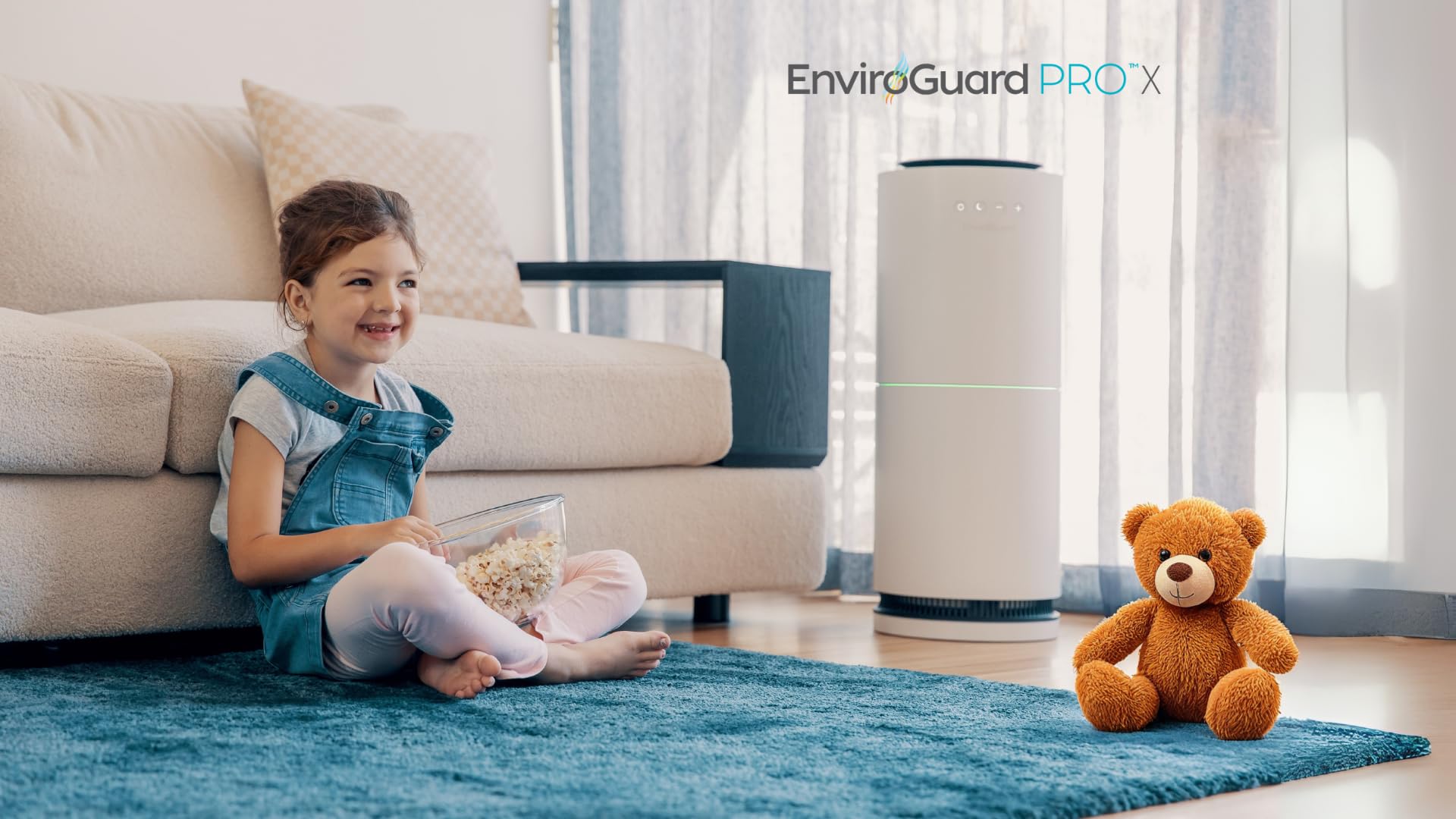
Indoors, the equivalent process is vapour phase oxidation: a controlled, low-concentration hydrogen peroxide vapour released into room air, which reacts with VOC molecules and breaks their chemical bonds apart into water vapour and oxygen rather than holding the gas in a porous filter and hoping room conditions never change. The VBreathe EnviroGuard PRO™X applies this principle through its Purox™ Gel system, working in parallel with a 4-stage PrimeProtect™ filter that still handles particulate matter the conventional way. You can read the full mechanism on our Purox™ Gel technology.
This isn’t a replacement for source control or ventilation it’s what fills the gap those two leave behind: the months of slow off-gassing from a new mattress, the VOCs that settle into a sofa or carpet fibre where airflow barely reaches, and the days when opening a window means trading one pollutant for another.
The clearest evidence for active vapour treatment isn’t a marketing claim it’s a documented remediation case. A 600m² commercial office in Cairns CBD was assessed at Grade 4 fungal contamination (per AMG 2010 standards), affecting roughly 100m² of surfaces and plasterboard, with active fungal growth confirmed at ANSI IICRC Condition 3. EnviroGuard PRO™X units running Purox™ Gel in Boost Mode were deployed one week ahead of the remediation crew.
In one heavily contaminated meeting room used as an isolated trial where the EnviroGuard PRO™X ran without a traditional HEPA air scrubber airborne fungal contamination measured by independent lab sampling dropped from 795 CFU/m³ to 4 CFU/m³ over the 14-week project. Across the building, post-remediation testing of more than 25 air samples returned fewer than 1 mould spore per sample, and over 20 surface samples returned zero viable mould spores and bacteria. The independent verification was conducted to ANSI IICRC S520 professional mould remediation standard.
That’s a fungal and surface-bioburden result rather than a TVOC-ppb measurement, but it demonstrates the mechanism this guide is describing at a scale no countertop unit or houseplant arrangement could touch: continuous, whole-space oxidation reaching surfaces and air simultaneously, independently verified, not self-reported.
| Method | What it does | Where it falls short |
|---|---|---|
|
Source control
|
Stops VOCs being released in the first place | Can’t undo materials already in your home |
|
Ventilation
|
Dilutes current airborne concentration fast | Temporary; conflicts with smoke/pollen seasons; does nothing for ongoing off-gassing |
|
Activated carbon
|
Physically captures gas molecules (adsorption) | Saturates and can release gas back; thin filters saturate in hours under heavy load |
|
Active vapour oxidation
|
Breaks VOC molecular bonds into water and oxygen | Requires a device; not a free or instant fix |
|
Houseplants
|
Negligible in real rooms outside lab chambers | Needs 680 plants per 1,500 sq ft to match lab-measured rates |
Curious how vapour phase oxidation works at the molecular level? Read the full breakdown on our Purox™ Gel, or see how the EnviroGuard PRO™X combines it with 4-stage medical-grade filtration.