Limited-time welcome offer — 10% off with code WELCOME10

✨ Fresh Update: Ut enim ad minim veniam, quis nostrud exercitation ullamco aboris nisi ut aliquip ex ea commodo consequat.

Limited-time welcome offer — 10% off with code WELCOME10

Top Ranked Air Purifiers for VOCs 2026: Beyond Dust Filtration Technology

Table of Contents Share Copy Link In recent years, the global focus on PM2.5 pollution has made people familiar with air purifiers and HEPA filters. However, by 2026, indoor air quality standards have shifted significantly. Scientists and public health experts now recognize that the real threat is not only dust
Top Ranked Air Purifiers for VOCs 2026
Today’s Air Quality
London, GB
12:47 AM
AQI 7
Air Quality Good
Air is clean and safe. No health risks expected. Everyone can enjoy outdoor activities without concern.
PM₂.₅
1.36
PM₁₀
2.22
SO₂
3.39
NO₂
6.69
O₃
84.8
CO
105.29
Top Ranked Air Purifiers for VOCs 2026

Table of Contents

Share

Today’s Air Quality
London, GB
12:47 AM
AQI 7
Air Quality Good
Air is clean and safe. No health risks expected. Everyone can enjoy outdoor activities without concern.
PM₂.₅
1.36
PM₁₀
2.22
SO₂
3.39
NO₂
6.69
O₃
84.8
CO
105.29

In recent years, the global focus on PM2.5 pollution has made people familiar with air purifiers and HEPA filters. However, by 2026, indoor air quality standards have shifted significantly.

Scientists and public health experts now recognize that the real threat is not only dust particles, but also invisible airborne chemicals known as VOCs (Volatile Organic Compounds). These are extremely small gas-phase pollutants that standard filters cannot capture.

VOCs are often found at higher concentrations indoors than outdoors. Unlike dust, they are gases, not particles, and can spread freely through air, ventilation systems, and building spaces.

This article explains the science behind VOCs and compares leading air purification technologies of 2026, focusing on how different systems handle chemical pollutants at a molecular level.

What Are VOCs (Volatile Organic Compounds)?

VOCs Are Gases, Not Particles

A major misunderstanding in air quality is treating all pollution as dust.

VOCs are gaseous chemical compounds, not solid particles like PM2.5. They evaporate easily at room temperature and spread invisibly throughout indoor spaces. Because of their gas form, no traditional dust filter can physically trap them.

They behave like air itself—diffusing everywhere, passing through gaps, and circulating through HVAC systems.

Common Indoor Sources of VOCs

VOCs are commonly released from everyday household items, such as:

  • Formaldehyde → plywood, furniture glue, flooring materials
  • Toluene & Benzene → paints, adhesives, cleaning products
  • D-limonene & fragrance chemicals → candles, air fresheners, perfumes

New furniture or freshly painted walls can continuously release these gases for weeks or even months (a process called off-gassing).

Health Effects of VOC Exposure

Short-term exposure may cause:

  • Headaches
  • Dizziness
  • Fatigue
  • Eye, nose, and throat irritation
  • Sick Building Syndrome

Long-term exposure to some VOCs (such as formaldehyde) has been linked to serious health risks, including carcinogenic effects, especially for children and sensitive individuals.

Why HEPA Filters Cannot Remove VOCs

Limits of HEPA Technology

HEPA filters (developed in 1942) are designed to trap solid particles, not gases. They are effective for dust, pollen, and PM2.5, but VOCs pass through them completely.

Activated Carbon Filtration

Activated carbon can absorb gas molecules through adsorption. However, it has limitations:

  • It does not destroy VOCs
  • It can become saturated over time
  • It may release trapped gases back into the air (outgassing)
  • It works best for short-term or low-level chemical exposure

2026 Air Purifier Technologies: Active vs Passive Systems

Most air purifiers are passive systems, meaning they must pull air through filters.

Newer advanced systems are moving toward active purification, where chemical reactions are used to break down pollutants in the air before they are inhaled.

These systems often use oxidation-based chemistry inspired by natural atmospheric processes, such as hydroxyl radicals formed by sunlight.

Top Air Purifiers for VOCs (2026 Comparison)

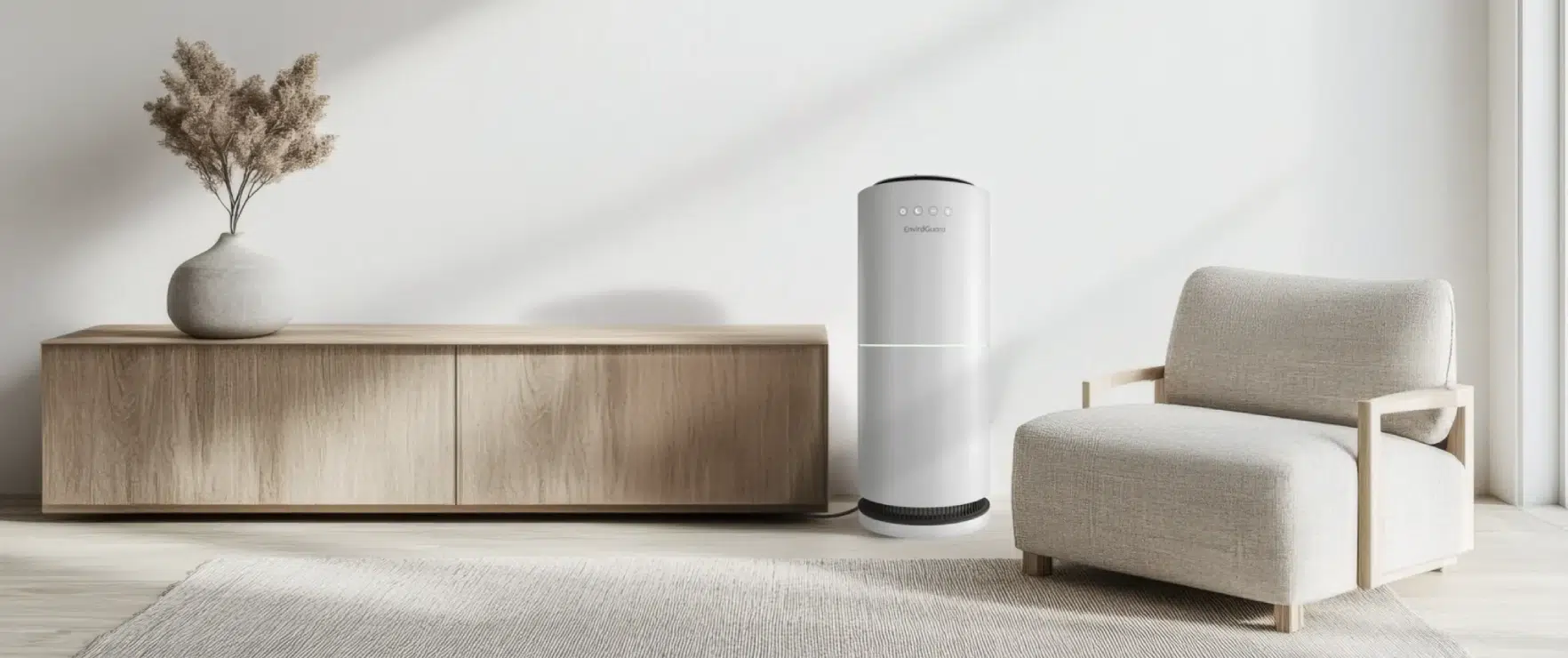
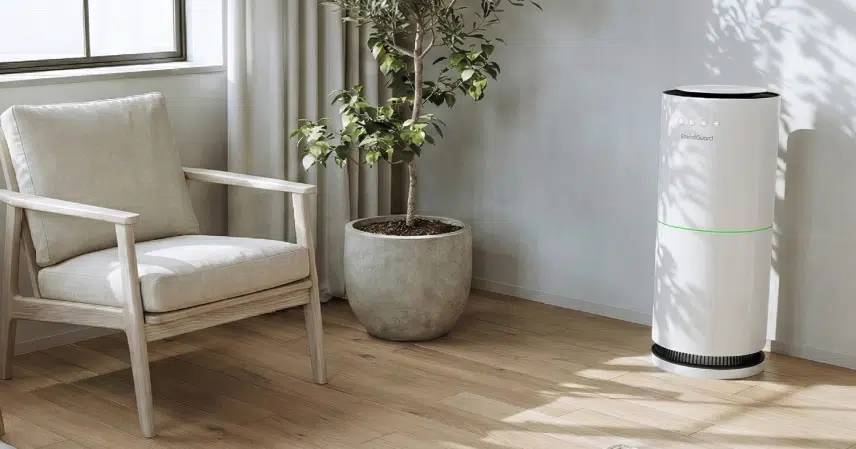
1.) Vbreathe (EnviroGuard PRO X) – An environmental system.

Top Ranked Air Purifiers for VOCs

Every air purifier you’ve ever seen filters. It waits for contaminants to come to the filter. Most never do.

Key Technology:

  • Exclusive Purox™ Gel Vaporization:
    Uses proprietary Purox™ Gel technology designed to safely diffuse a controlled 5.8% medical-grade hydrogen peroxide vapor into the air.

  • Proactive VOC Eradication:
    Actively targets and breaks down complex volatile organic compounds (VOCs), including hard-to-remove airborne toxins such as formaldehyde and toluene, at the molecular level.

  • Pristine Elemental Conversion:
    Transforms airborne pollutants and contaminants into harmless natural components, specifically pure water vapor (H₂O) and oxygen (O₂).

  • 4-Stage Filtration System:
    Each filter layer works together to capture and trap particles of various sizes, from large to fine dust, improving overall air cleanliness before the air moves to the next stage and enhancing the efficiency of the gel system.
Cons
  • Not good for spaces larger than 1500m2.
Pros
  • Active purification reaches all areas of a room
  • Completely breaks down chemical pollutants
  • Anti-mold and antibacterial protection in filters
Summary: Best for new homes, renovations, or environments with chemical contamination

2. Dyson Purifier Big+Quiet Formaldehyde – Airflow Engineering Leader

Dyson focuses on air circulation and formaldehyde breakdown.

Key Technology:

  • Uses Coandă effect airflow design
  • Projects clean air over long distances
  • SCO catalytic filter breaks down formaldehyde permanently
  • Carbon filter captures NO₂ and other gases
Cons
  • It waits for contaminants to come to the filter.
  • Less effective for a wide range of VOC types
  • The airflow angle can only be adjusted vertically (0–50 degrees). It cannot oscillate or spread air across different corners of the room.
  • Delayed sensor response in obstructed or large spaces: In wide rooms or areas with physical barriers, the built-in sensor may take longer to detect dust or odors coming from distant or blocked corners of the room.
  • Limited mobility on uneven surfaces: The hidden caster wheels work well on flat floors, but on thick carpets or uneven surfaces such as door thresholds, users may need to lift the unit, which can be difficult due to its heavy weight.
Pros
  • Strong airflow coverage for large spaces
  • Permanent formaldehyde breakdown filter
  • Quiet operation
Summary: Best for large open spaces and light manufacturing environments where industrial byproducts, heavy particulate matter, and specific chemical gases like formaldehyde need to be continuously broken down across an expansive floor plan.

3. InovaAir E20 – High-Mass Activated Carbon System

A heavy-duty filtration approach using physical adsorption.

Key Technology:

  • 6 kg industrial-grade activated carbon
  • HEPA H13 filtration system
  • No sensors or automation (continuous full-power operation)
Cons
  • It waits for contaminants to come to the filter.
  • Large and heavy design
  • Noisy at high speed during quick odor removal: Without Auto mode, it can run loudly on maximum fan speed until manually adjusted.
  • No smart features or auto mode: Lacks display and sensors, so users cannot monitor air quality or know when to reduce speed.
  • Heavy and expensive filter maintenance: The ~6 kg carbon filter is difficult to replace and comes with high replacement cost.
Pros
  • Extremely strong chemical absorption
  • Long filter lifespan
Summary: Best for strong chemical environments like paint, renovation, or workshops.

4. Mila Air Purifier – Customizable Filtration System

Mila allows users to choose filters based on specific needs.

Key Technology:

  • Multiple filter types (7 options)
  • “Home Wrecker” filter for renovation and odors
  • Smart sensors for PM and gas detection
Cons
  • It waits for contaminants to come to the filter.
  • Passive system (depends on airflow reach)
  • The maintenance cost of these specialized filters is significantly higher than standard HEPA filters.
  • From real user feedback, issues such as whistling noise or abnormal fan motor/bearing noise are often reported after the unit has been used continuously for a period of time.
Pros
  • Highly flexible filter customization
  • Good smart app and monitoring
Summary: Best for users who want customizable, smart home control.

5. Winix & Molekule – Plasma and Light-Based Systems

These brands use energy-based oxidation technologies.

Winix (PlasmaWave):

  • Generates hydroxyl radicals
  • Breaks down pollutants chemically in the air

Molekule (PECO):

  • Uses light-activated nanotechnology
  • Breaks VOCs into CO₂ and water
Cons
  • It waits for contaminants to come to the filter.
  • Limited carbon filtration capacity
  • Takes longer to purify the air: Because it relies on chemical reactions and light-based processes, it removes heavy particles such as PM2.5 more slowly compared to high-airflow machines.
  • Possible minor side effects: Plasma systems may generate very low levels of ozone, and some users may experience mild irritation or notice a slight odor.
Pros
  • Advanced molecular-level treatment
  • Reduces microbes and chemical pollutants
Summary: Best for allergy-sensitive users and hygiene-focused environments.

6. Levoit EverestAir®-P – Smart Sensors and Wall-Hugging Design

This model combines a high-capacity 3-stage filtration system with smart home features in a sleek, wall-hugging design. 

How the Levoit EverestAir®-P Works:

  • 3-Stage Filtration: Uses a washable Pre-Filter, an H13 True HEPA filter, and an Activated Carbon filter to capture debris, fine dust, and odors (VOCs).
  • Precision Laser Sensors: Accurately tracks PM1.0, PM2.5, and PM10 particles in real-time on the display.
  • Wall-Hugging Airflow: Pulls air from the front and sides, then pushes it upward. This allows you to place the unit completely flat against a wall.
  • Smart Control: Seamlessly connects to the VeSync app, Amazon Alexa, and Google Assistant.
Cons
  • Passive System: It relies on waiting for contaminants to be pulled into the filter.
  • Auto Mode Ignores Odors: Sensors only detect physical particles. The fan won't speed up automatically for smells or VOCs.
  • Sensor Confusion: May mistake moisture (from humidifiers or cooking steam) for dust, triggering high speeds.
  • Tech Limits: Requires a 2.4GHz Wi-Fi network to connect, and the highest fan speed can be startlingly loud.
Pros
  • Fast & Powerful: High CADR (354–360 CFM) cleans large spaces quickly, and the sensor reacts instantly to dust spikes.
  • Space-Saving: Massive room coverage without taking up valuable floor space.
  • Fully Certified: Backed by ENERGY STAR, CARB, FCC, and ETL.
Summary: Best for tech-savvy users, allergy sufferers, and pet owners who need powerful, data-driven purification for large rooms but want a space-saving unit.

7. Coway Airmega 400 – Dual Filtration and Smart Sensor System

This model uses a high-capacity dual suction design combined with intelligent environmental sensors for fast, targeted purification.

Coway Airmega 400:

  • Dual Filtration: Draws in air from two sides using 4 filters in total (2 washable Pre-filters and 2 Max2 HEPA + Activated Carbon filters).
  • Microscopic Purification: Captures everything from large debris like pet hair to ultra-fine particles down to 0.1 microns.
  • Smart Modes: Uses pollution, light, and filter sensors to automatically switch between Auto, Eco, and Sleep modes based on the room’s conditions.
Cons
  • Passive System: It relies on waiting for contaminants to be pulled into the machine.
  • High Maintenance Cost: You must replace two sets of Max2 filters simultaneously.
  • Bulky & Hard to Clean: It takes up more floor space than standard purifiers, and the non-removable top grille easily traps dust when the fan is off.
  • Sleep Mode Blind Spot: When the room is dark, the fan locks at the lowest speed and will not speed up even if air quality drops during the night.
Pros
  • Fast & Massive Coverage: The dual air intake provides high CADR, cleaning large spaces and open floor plans very quickly.
  • Highly Energy-Efficient: Features an Eco Mode that completely stops the fan when the air remains clean for 10 minutes.
  • Accurate Filter Tracking: Calculates filter lifespan based on actual airflow and usage, rather than a basic timer.
Summary: Best for large open-plan spaces, living rooms, and users who want an energy-efficient, fully automated purifier with powerful HEPA performance.

Conclusion: Choosing the Right VOC Air Purifier in 2026

HEPA filters alone are no longer enough for modern indoor air challenges. VOCs require either:

  • Strong adsorption (carbon-heavy systems)
  • OR active chemical breakdown (oxidation-based systems)

Recommendations:

  • Severe VOC / renovation homes: Vbreathe or InovaAir
  • Large open spaces: Dyson
  • Flexible smart control: Mila
  • Advanced experimental tech: Winix / MolekuleGeneral household use: Levoit / Coway
FAQ
Q1: Can a standard PM2.5 air purifier also remove odors and chemicals from new furniture?
No. HEPA filters capture solid particles, not gases. VOCs from furniture are molecular gases that can pass through HEPA filters. Effective removal requires high-quality activated carbon or technologies that can break down chemical compounds.
Q2: How long do VOCs from paint and built-in furniture remain in the air?
VOCs such as toluene and benzene released from paint and built-in furniture can remain in indoor air for several weeks to several months, and in some cases up to a year, depending on materials, temperature, and ventilation. As a result, newly built or renovated spaces may continue to emit VOCs for an extended period.
Q3: Is Vbreathe’s Vapour Phase Oxidation technology similar to ozone generators?
No. It is different and designed to be safer. It uses a controlled oxidation process inspired by natural reactions and does not produce harmful ozone, making it suitable for continuous indoor use.
Q4: What symptoms may indicate formaldehyde exposure in the home?
Possible symptoms include headaches, dizziness, nausea, eye or throat irritation, and fatigue, which often improve after leaving the space.
Q5: Is using a fan or opening windows enough to control VOCs?
Ventilation helps reduce VOC levels temporarily but does not stop ongoing emissions. Continuous reduction or breakdown systems are needed for long-term control.
Q6: Can Dyson's SCO filter destroy other VOCs besides formaldehyde?
No, the SCO filter is strictly selective and only destroys formaldehyde. However, the machine handles other VOCs and odors by pulling them into its K-Carbon filter. This carbon layer simply traps the chemicals and will eventually need to be replaced when full.
London, GB
2:47 AM Jun 6, 2026
weather image
56
°F °C
overcast clouds
57 °
54 °
Feels like °
AQI 7
Air Quality Good
PM₂.₅
1.36
PM₁₀
2.22
SO₂
3.39
NO₂
6.69
O₃
84.8
CO
105.29
Weather Forecast
  • Weather
  • AQI
Today 07 Jun
weather image
54° 57°
Tomorrow 08 Jun
weather image
52° 71°
Monday 09 Jun
weather image
53° 60°
Tuesday 10 Jun
weather image
49° 65°
Wednesday 11 Jun
weather image
48° 63°

Recommended for you

¹ Tested in independent Australian laboratories under controlled conditions using airborne mould spores, bacteria and allergen particulates (0.3μm–10μm).
² Based on third-party testing results confirming 99.9% reduction in airborne mould spores and pet dander when using EnviroGuard Pro X with Purox™ Gel over 24 hours.
³ Independent testing by ICAS Testing Technology Service (Shanghai) Co., Ltd. demonstrated 99.99% reduction in airborne Staphylococcus Albus bacteria within 30 minutes in a 20m² test chamber, in accordance with Technical Standard for Disinfection GB 27948-2020.
⁴ Surface efficacy testing conducted by Eurofins BioPharma Product Testing — Sydney (Eurofins ams Laboratories Pty Ltd, TGA-licensed under MI-2021-LI-08995-1). Reductions over 8 hours: 99.99% Pseudomonas Aeruginosa, 99.9% Escherichia Coli, 90% Candida Albicans Yeast.
⁵ "10x faster than conventional filtration" comparison based on EnviroGuard Pro X achieving log 4 (99.99%) airborne bacterial reduction in 30 minutes, compared with log 1 (90%) pathogen reduction in 20 minutes reported for hospital HEPA systems operating at 12 air changes per hour (Fernstrom A, Goldblatt M. Aerobiology and its role in the transmission of infectious diseases. J Pathog. 2013;2013:493960).
⁶ Performance varies based on room size, airflow configuration, fan speed setting, environmental conditions and usage patterns.

Remove

Cart (0)
No products in the cart
Subtotal
$0.00
Add +

Total Amount