Air is clean and safe. No health risks expected. Everyone can enjoy outdoor activities without concern.
PM₂.₅
2.23
PM₁₀
2.81
SO₂
2.78
NO₂
11.12
O₃
44.41
CO
126.05
Table of Contents
Share
Today’s Air Quality
London, GB
10:09 AM
Air QualityGood
Air is clean and safe. No health risks expected. Everyone can enjoy outdoor activities without concern.
PM₂.₅
2.23
PM₁₀
2.81
SO₂
2.78
NO₂
11.12
O₃
44.41
CO
126.05
Indoor air quality inside enclosed bedrooms directly dictates overnight physiological recovery, cardiovascular health, and sleep architecture. While modern wellness strategies prioritize diet and exercise, airborne particulate matter (PM2.5), volatile organic compounds (VOCs), and biological allergens accumulate in sealed bedrooms, converting resting spaces into high-density exposure zones. Integrating an evidence-based bedroom air management system actively neutralizes airborne threats, transforming the sleep environment into a clean breathing sanctuary required for uninterrupted, restorative rest.
Why Allergies and Breathing Issues Spike at Night
Nighttime allergy exacerbations occur due to the direct convergence of horizontal respiratory physiology and concentrated indoor allergen microenvironments. When the human body transitions to a supine position, blood flow redistributes toward the upper respiratory tract, naturally narrowing nasal passages and slowing lymphatic mucus drainage. In sealed bedrooms, stagnant air allows airborne particles to concentrate, forcing the respiratory system to process high loads of foreign antigens during rest.
The “Pocket Problem” & Localized Allergen Exposure
The primary driver of nocturnal respiratory distress is The Pocket Problem—a high-density allergen reservoir generated continuously within the bedding microenvironment.
The Microenvironmental Trap: Dust mites (Dermatophagoides pteronyssinus) require relative humidity above 50% to survive because dust mites absorb moisture directly from ambient air. The narrow space between a sleeper’s body, mattress, and duvet creates a localized pocket of elevated heat and metabolic moisture inches from the nose and mouth, sustaining optimal mite breeding conditions regardless of baseline room humidity.
Aggressive Biological Antigens: The primary triggers are fecal and body protein fragments—specifically Der p 1 and Der p 2 proteins—which possess enzymatic properties that actively degrade the protective mucus barrier of human respiratory epithelium.
Microscopic Biological Particles: Alongside dust mite proteins, airborne mould spores, pet saliva & skin proteins, and microscopic pollutants down to 0.01μm remain suspended in stagnant air zones or settle into bedding fibers, triggering chronic mucosal irritation upon the slightest movement in bed.
Histamine Spikes, REM-RDI & Long-Term Health Risks
Inhaled nocturnal allergens trigger mast cells in the airway to release Histamine and pro-inflammatory mediators, altering neural sleep regulation and oxygen intake.
Neurochemical Sleep Disruption
Histamine functions as a wake-promoting neurotransmitter within the central nervous system. When airway tissues release histamine overnight, it can severely compromise overall sleep quality by interfering with deep slow-wave sleep and contributing to sleep-stage fragmentation. This may result in frequent microarousals without conscious awakening, leaving sleepers feeling physically and cognitively unrefreshed the following day.
The REM-RDI Clinical Metric
Clinical research published in the American Journal of Otolaryngology has reported that dust mite-sensitised individuals can experience an elevated Respiratory Disturbance Index during REM sleep (REM-RDI). Airway inflammation can restrict airflow during REM sleep—the stage associated with memory consolidation and neurological restoration—potentially triggering repeated, unconscious partial arousals as the body works to maintain airway function.
Long-Term Systemic Complications
Population studies and long-term respiratory research have associated chronic nighttime exposure to fine particulate matter (PM2.5) and sustained nocturnal inflammation with systemic physiological stress. Over time, persistent nighttime respiratory strain may be associated with:
Daytime Fatigue & Cognitive Impairment Fragmented sleep can reduce the amount and quality of restorative sleep, contributing to daytime fatigue and impaired cognitive performance.
Cardiovascular Strain & High Blood Pressure (Hypertension) Repeated nighttime respiratory disturbances may increase sympathetic nervous system activity, placing additional strain on the cardiovascular system.
Elevated Risk of Heart Disease & Metabolic Dysregulation Chronic sleep fragmentation and low-grade inflammation have been associated with cardiovascular and metabolic health risks, including weight gain and obesity.
Increased Vulnerability in Chronic Respiratory Conditions People living with chronic respiratory conditions such as Asthma, COPD (Chronic Obstructive Pulmonary Disease), or Pulmonary Fibrosis may be particularly vulnerable to sustained nighttime exposure to airborne allergens and particulate matter.
Passive HEPA vs. Active Air Management: What Actually Works for Bedrooms?
Passive HEPA filtration relies on drawing room air through physical filter media, while Active Air Management distributes active treatment throughout the room.
HEPA filtration provides an essential baseline for capturing airborne particles that reach the purifier. However, filtration depends on airflow reaching the intake and does not directly treat stationary surfaces such as mattresses, pillows or bedding.
Mechanism Comparison: Passive vs. Active
Evaluation Factor
Passive HEPA Filtration
Advanced Solution
Environmental system (VPO)
Core Mechanism
Pulls air through mechanical filter media.
Distributes active vapour throughout the environment.
Particle Capture
≥99.97% at 0.3 μm (Requires particles to reach the filter unit)
HEPA + Active Room Treatment(Treats air beyond the unit)
Ultrafine Particles
Varies by particle size, airflow, and filter.
Chemical treatment mechanism(Does not rely solely on physical capture)
Surface Reservoirs
Cannot treat contaminants on bedding or surfaces.
Vapour interacts directly with exposed surfaces.
VOCs & Chemicals
Finite capacity (Carbon adsorbs certain gases)
Chemically reacts with gaseous contaminants.
Biological Contaminants
Captures airborne particles that enter the filter.
Must verify ozone emissions for the specific system.
The Physical Limits of Passive Trapping and "Dead Zones"
Passive air purifiers use a fan to draw room air through a Pre-Filter → True HEPA H13 → Activated Carbon pathway before returning treated air to the room.
1. Gravitational Particle Settling
Dust-mite allergens and proteins associated with pet saliva and skin can settle onto mattresses, duvets, flooring and other surfaces.
Because passive filtration depends on contaminants reaching the intake, particles that have already settled are outside the filter’s immediate airflow path.
2. Stagnant Aerodynamic Zones
Beds, wardrobes and bedside furniture can create low-airflow areas where contaminants may not efficiently reach the purifier.
Effectiveness therefore depends on airflow patterns, purifier placement, room geometry and operating speed, particularly around the sleeper’s breathing zone.
3. Carbon Adsorption Capacity
Activated Carbon adsorbs certain VOCs and gaseous contaminants rather than chemically destroying them.
Performance depends on carbon mass, media type, contaminant concentration, humidity, airflow and contact time. As adsorption capacity decreases, overall gas-removal performance can also decline.
Vapour Phase Oxidation (VPO) and Molecular-Level Treatment
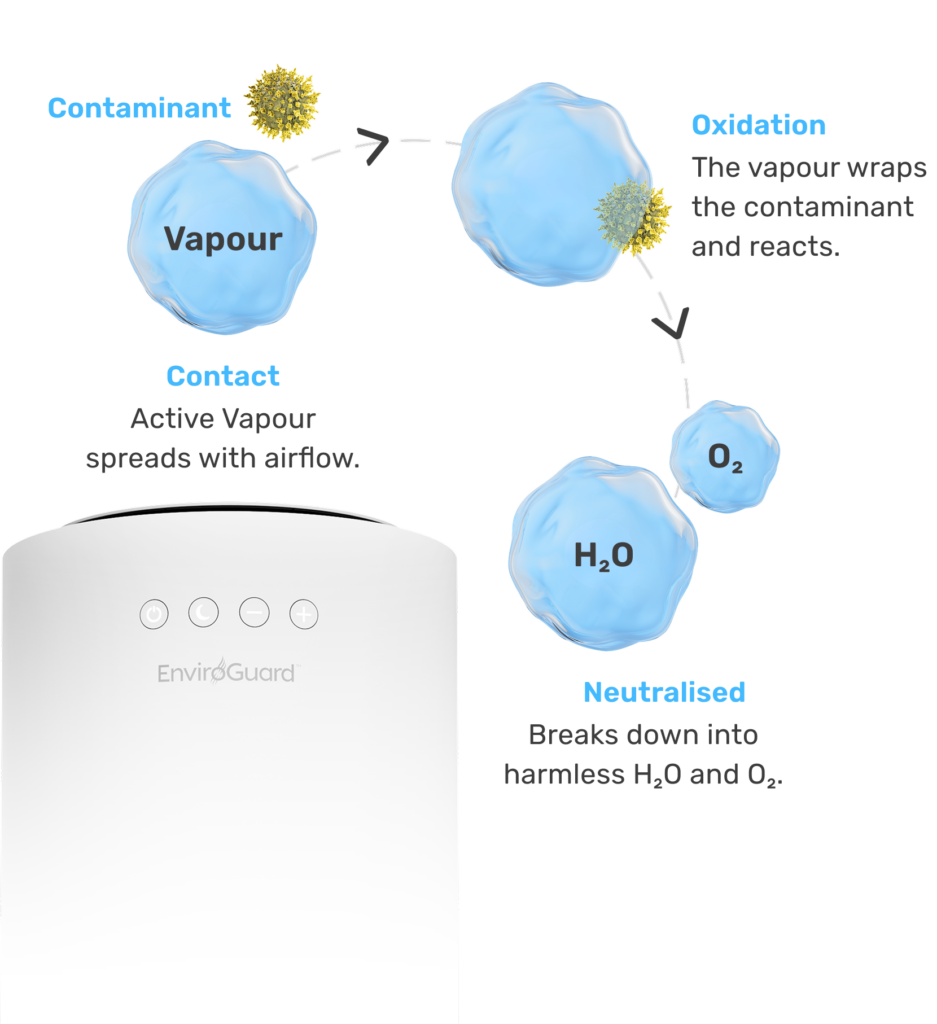
Vapour Phase Oxidation (VPO) distributes active vapour throughout the treated environment, allowing the treatment chemistry to interact with susceptible contaminants in both air and exposed surfaces.
Active VPO Device → Active Vapour → Airborne Treatment | Surface Interaction | Gaseous Contaminant Treatment
1. Formaldehyde and VOC Treatment
Formaldehyde (HCHO) and other VOCs can be continuously released from furniture, composite wood, foam materials, adhesives and synthetic textiles.
While activated carbon relies on adsorption, VPO uses oxidation chemistry to react with susceptible gaseous contaminants. Performance should be supported by product-specific testing.
2. Thirdhand Smoke Residues
Tobacco smoke can leave persistent chemical residues on curtains, walls, furniture and bedding.
Active vapour treatment is designed to interact with exposed surface contaminants and may reduce susceptible chemical residues through oxidation, depending on concentration, contact time and surface conditions.
3. Biological Contaminant Inactivation
Active oxidative treatment can interact with susceptible bacteria, viruses and fungal organisms.
Where validated, sufficient exposure can damage cellular structures, membranes or proteins and reduce biological activity. Results depend on the specific organism and test conditions.
4. Microscopic Contaminants
HEPA filtration removes particles through physical capture, while active vapour treatment operates through chemical interaction.
Claims regarding treatment at specific particle sizes, such as 0.01 μm, should be supported by a defined test method and should not be presented as equivalent to HEPA particle-capture efficiency.
5. Ozone Safety and Compliance
Active vapour systems can be engineered to operate without intentionally generating ozone.
For any air purifier for bedroom applications, ozone emissions should be independently verified for the specific device and operating conditions. Claims such as 100% Ozone-Free or CARB compliance should be supported by the relevant product-specific certification or laboratory documentation.
Bedroom Air Purification Technologies: Comprehensive Category Comparison
Modern residential air purification systems can be grouped into five broad technology categories. Each differs in particle capture, chemical treatment, surface interaction, and bedroom safety.
The key distinction is whether a system primarily captures contaminants that reach the filter or also provides an active treatment mechanism within the surrounding environment.
Air Purification Technology Matrix
01
Active VPO + True HEPA
Top Solution
Particulate & Bio-Capture
HEPA capture + active treatment
Chemical & VOC Handling
VPO oxidation of susceptible contaminants
Bedding & Surface Treatment
Active treatment of exposed surfaces
Sleep Noise & Safety
Low-noise operation; ozone performance should be verified
02
Mechanical True HEPA + Carbon
Particulate & Bio
≥99.97% at 0.3 μm under applicable test conditions
Chemical & VOC
Activated Carbon adsorption
Surface Treatment
Primarily treats contaminants reaching the intake
Noise & Safety
Mechanical filtration does not generate ozone
03
Budget Synthetic / Electrostatic
Particulate & Bio
Variable particle capture
Chemical & VOC
Limited carbon capacity
Surface Treatment
Primarily dependent on airflow
Noise & Safety
Performance and noise vary by device
04
Photocatalytic Oxidation (PCO)
Particulate & Bio
Often combined with particle filtration
Chemical & VOC
Photocatalytic treatment of selected compounds
Surface Treatment
Mainly limited to the treatment chamber
Noise & Safety
UV and by-product control require evaluation
05
Bipolar Needle-point Ionization
Particulate & Bio
Charges and aggregates particles
Chemical & VOC
Limited direct gas treatment
Surface Treatment
Does not directly remove settled contaminants
Noise & Safety
Ozone and NOx emissions depend on device design
Category 1: Active Vapour Phase Oxidation (VPO) + True HEPA
Advantages
Combines True HEPA filtration with Active Vapour Phase Oxidation (VPO).
Addresses both airborne particles and selected contaminants in the surrounding environment.
Active treatment can interact with susceptible biological contaminants, including Der p 1 / Der p 2 and pet-associated proteins.
VPO can chemically react with selected VOCs, including targeted compounds such as Formaldehyde.
Suitable for users seeking broader air and environmental management.
Key Considerations
Active-treatment performance depends on vapour concentration, exposure time and environmental conditions.
Specific claims should be supported by product-level testing.
Ozone (O₃) emissions should be independently verified for the specific system.
Charges airborne particles to encourage aggregation.
Can reduce the concentration of suspended particles under suitable operating conditions.
Compact technology can be integrated into relatively small air-cleaning systems.
Key Considerations
Particle aggregation is not the same as contaminant destruction.
Without effective collection, particles may deposit onto floors, furniture or bedding.
Some ionization technologies can generate Ozone (O₃) and potentially NOx.
Emissions should be independently tested for the specific device and operating conditions.
5 Non-Negotiable Features to Check Before Buying
For bedroom use, look beyond filter type and compare measurable factors that affect sleep comfort, air delivery and chemical safety.
Bedroom Air Purifier Specification Checklist
Feature
Recommended Check
Why It Matters
01
Sleep Noise
≤33 dB(A) at Sleep Mode
Minimises unwanted acoustic disturbance.
02
Air Delivery
Target around 4 ACH or more
Provides adequate room air turnover.
03
Display Blackout
Full LED/display-off mode
Keeps the sleeping environment dark.
04
VOC & Gas Handling
Adequate Activated Carbon or validated molecular treatment
Helps manage gaseous contaminants.
05
Ozone Emissions
Independently verified low/zero ozone
Important for enclosed bedroom environments.
1. Sleep Noise
Check the actual Sleep Mode noise level, not only the lowest fan setting.
Prefer independently tested dB(A) measurements.
2. Air Delivery
Match purifier airflow to the actual bedroom volume.
Use ACH as a practical benchmark for comparing room coverage.
[CODING SECTION — ACH / CADR CALCULATOR]
Room Volume = Floor Area × Ceiling Height
Required Airflow = Room Volume × Target ACH
Build an interactive calculator here.
3. Display Blackout
Look for a dedicated Display Off / LED Off / Blackout Mode.
Confirm the purifier continues operating while the display is disabled.
4. VOC & Gaseous Contaminants
Activated Carbon works through adsorption and has finite capacity.
Compare carbon quantity and validated VOC performance, not simply the presence of a carbon layer.
For VPO, check product-specific evidence for the gases or VOCs tested.
5. Ozone Safety
Check independent Ozone (O₃) emission testing.
Pay particular attention to ionisation, corona-discharge and UV-based technologies.
Verify certification or testing for the specific device and operating mode.
Optimal Placement & Operating Guide: How to Maximize Sleep Benefits
Where and how an air purifier operates can affect how effectively it treats the air around the sleeper. Correct placement, airflow direction and consistent runtime help maximise room air circulation and minimise stagnant zones.
1. Place the Purifier Near the Sleeping Zone
Position the purifier roughly 1–2 metres from the bed where practical.
Direct the clean-air outlet upward or laterally, rather than directly at the face.
Avoid placing the unit behind curtains, furniture or other objects that restrict airflow.
2. Maintain Adequate Clearance
Keep approximately 30–50 cm clearance around the air intake and exhaust.
Avoid tight corners, enclosed shelves or spaces between large pieces of furniture.
The goal is to maintain unrestricted airflow rather than simply positioning the purifier as close to the bed as possible.
3. Run Consistently, Especially Overnight
For continuous air-quality management, running the purifier consistently is generally preferable to switching it on only when entering the bedroom.
Use Sleep Mode overnight if the purifier provides adequate airflow at a lower noise level.
Continuous operation helps maintain more stable airborne-particle concentrations as new contaminants are generated.
4. Keep Doors and Windows Closed When Targeting One Bedroom
When treating a specific bedroom, keeping the door and windows closed helps maintain the intended room volume and airflow rate.
Opening doors or windows introduces additional air exchange and can reduce the purifier’s effective ACH within the bedroom.
If ventilation is required, use it according to the room’s ventilation needs rather than relying on the purifier as a replacement for fresh-air ventilation.
5. Consider the Unit’s Height and Airflow Path
Compact units may perform better when positioned where their intake and outlet have clear access to room air.
Avoid placing the intake directly beside heavy dust reservoirs such as carpets or under-bed areas unless the device is specifically designed for that position.
Always prioritise the manufacturer’s recommended clearance and placement requirements.
Practical Rule: Near the sleeping zone + clear airflow + adequate clearance + consistent operation + appropriate ventilation = more effective bedroom air management.
Practical Bedroom Allergen Control Guide
An air purifier helps reduce airborne particles and gases, but it cannot remove allergen sources that have already settled into mattresses, pillows and bedding. For better bedroom allergen control, combine air purification with simple cleaning and moisture-control habits.
1. Wash Bedding Regularly
What to do
Wash sheets, pillowcases and duvet covers regularly.
Where the fabric allows, use a 54–60°C (130–140°F) wash cycle.
Dry bedding thoroughly, preferably using a heated dryer cycle.
What you get
Helps remove dust mites, mite debris and Der p 1 / Der p 2 allergens from bedding.
Hot washing is more effective at reducing dust mites than cold or lukewarm washing.
Practical tip: Always follow the care label for each bedding item.
2. Let the Bed Air Out Before Making It
What to do
After waking, fold the duvet or blankets back.
Leave the bed uncovered for around 15–30 minutes before making it.
What you get
Allows heat and moisture from overnight use to escape.
Helps keep the mattress and bedding drier, making the environment less favourable for dust mites.
Practical tip: This is a simple habit that can be added to your morning routine.
3. Keep Hair Dry Before Bed
What to do
Dry your hair thoroughly before going to sleep.
Avoid going to bed with wet or damp hair, especially when using pillows or bedding that retain moisture.
What you get
Reduces unnecessary moisture around pillows and bedding.
Helps keep the sleeping environment drier and less favourable for microbial growth.
4. Use Allergen-Protective Mattress and Pillow Covers
What to do
Use tightly woven, zippered allergen encasements on mattresses and pillows.
Choose products specifically designed to reduce exposure to dust-mite allergens.
Wash the covers according to the manufacturer’s instructions.
What you get
Creates a physical barrier between the sleeper and allergens stored inside mattresses and pillows.
Helps prevent new allergen material from building up inside the bedding.
Look for: A tightly woven fabric with a tested pore size suitable for allergen protection.
5. Keep Pets Out of the Sleeping Area
What to do
Keep pets off the bed and, where possible, outside the bedroom.
Wash bedding and fabrics that pets regularly contact.
Vacuum areas where pet hair and dander accumulate.
What you get
Reduces the amount of pet dander, skin particles and dried saliva proteins entering the sleeping environment.
Reduces the allergen load that an air purifier needs to manage.
Important: Air purification can help manage airborne pet allergens, but reducing the source remains an important part of overall allergen control.
The Simple Bedroom Allergen Routine
Wash bedding regularly → Air the bed → Keep hair dry → Protect the mattress and pillows → Keep pets away from the sleeping zone → Run the air purifier consistently.
The goal is not to rely on one method. Source control + bedding hygiene + moisture control + air purification provides a more complete approach to managing bedroom allergens—learn more in our full guide on How to Allergy-Proof Your Home.
Frequently Asked Questions
Do medical professionals recommend bedroom air purifiers?
Air purifiers can be used as part of an overall approach to managing indoor allergens and air quality. True HEPA filtration can help reduce airborne particles such as dust, pollen and pet allergens.
However, an air purifier is not a medical treatment or a replacement for prescribed care. For people with asthma, allergic rhinitis or other respiratory conditions, it should be used alongside appropriate medical treatment and practical allergen-control measures.
Are budget air cleaners effective for bedroom allergies?
Budget air cleaners can reduce airborne particles, but performance varies significantly between models. When choosing an air purifier for allergies, look beyond price and check:
CADR or airflow suitable for the room size
Genuine HEPA filtration
Filter quality and replacement requirements
Activated Carbon capacity if VOCs or odours are a concern
Noise level during Sleep Mode
Ozone emissions and the technology used
A low-cost unit is not automatically ineffective, but a lower price may mean less airflow, less filter media or fewer features.
Is it safe to sleep near an air purifier?
Generally, an appropriately designed and tested air purifier can be used while sleeping. For bedroom use:
Choose a model with a quiet Sleep Mode, ideally around 33 dB(A) or below if low noise is important.
Check the manufacturer's or independent ozone-emission test results.
Keep the air outlet clear.
Avoid directing a strong airflow directly at your face.
Follow the manufacturer's recommended clearance and placement instructions.
Placing the unit roughly 1–2 metres from the bed can provide effective circulation without placing the outlet directly beside the sleeper.
Can clean bedroom air reduce snoring?
It can help when nasal congestion from airborne allergens contributes to snoring. Reducing exposure to allergens such as dust-mite allergens, pollen and pet allergens may help reduce nasal irritation and congestion in sensitive individuals.
However, an air purifier cannot address every cause of snoring. Persistent or loud snoring, breathing pauses, gasping during sleep or significant daytime sleepiness should be discussed with a healthcare professional, as these can be associated with conditions such as obstructive sleep apnoea.
How long does an air purifier take to clean a bedroom?
The time depends on: room volume, airflow or CADR, filter efficiency, starting particle concentration, door and window conditions, and purifier placement.
A useful benchmark is Air Changes per Hour (ACH). For example, a purifier delivering around 4 ACH theoretically passes a volume of air equivalent to the room volume through the purifier four times per hour.
Airborne particles can be reduced relatively quickly, but new particles are continuously introduced through movement, bedding, clothing, doors and ventilation. For this reason, consistent operation is generally more effective than running the purifier only for a short period before sleep.
A Complete Bedroom Air-Quality Approach
An air purifier works best as one part of a broader bedroom air-management strategy.
1. Choose the right technology
Look for True HEPA filtration for airborne particles. If VOCs and odours are important, consider Activated Carbon or a validated active treatment technology.
2. Match performance to the room
Check the purifier’s CADR/airflow and room volume rather than relying only on the manufacturer’s room-size label. Use ACH as a practical way to compare air delivery.
3. Prioritise sleep comfort and safety
Look for:
Low Sleep Mode noise
Display blackout
Appropriate airflow
Verified ozone-emission performance
Clear manufacturer placement requirements
4. Control allergen sources
Air purification should be combined with simple source-control habits:
Wash bedding regularly using an appropriate temperature for the fabric.
Allow bedding to air after sleeping.
Keep mattresses and pillows protected with suitable allergen covers.
Keep pets away from the sleeping area when pet allergens are a concern.
Reduce dust accumulation around the bed.
The Practical Formula
Source Control + Bedding Hygiene + Moisture Control + Effective Air Filtration + Consistent Operation = Better Bedroom Air Management
Lorem ipsum dolor sit amet, consectetur adipiscing elit. Ut elit tellus, luctus nec ullamcorper mattis, pulvinar dapibus leo.
Medical & Environmental Disclaimer
This guide is provided for general environmental hygiene and educational purposes. It is not a substitute for medical diagnosis, treatment or individual healthcare advice.
People with asthma, severe allergies, COPD, sleep-related breathing problems or other chronic respiratory conditions should follow advice from their healthcare professional. Air purification should be considered an environmental management measure rather than a medical treatment.
Scientific & Technical Sources
Use authoritative sources to support specific claims about air cleaners, asthma, allergens, ozone emissions and indoor air quality. Where a product-specific performance claim is made, use the manufacturer’s test data or independent laboratory testing for that specific model.
Potential reference sources include:
National Heart, Lung, and Blood Institute (NHLBI/NIH) — asthma and respiratory health guidance.
National Asthma Council Australia — asthma and indoor-environment information.
California Air Resources Board (CARB) — ozone-emission requirements and air-cleaner information.
AHAM — Clean Air Delivery Rate (CADR) and air-cleaner performance information.
Relevant peer-reviewed research on dust-mite allergens, indoor air quality, respiratory symptoms and sleep.
Limited-Time Offer
Transform Your Indoor Air Quality
Upgrade to the innovative EnviroGuard PRO™ X today for only $790 (Was $1,590). Claim your $800 saving now and breathe cleaner, healthier air tomorrow.
How to Get Rid of Dust in Your Bedroom Quick answer: To reduce dust in your bedroom, deal with two things at the same time: dust that settles on surfaces and fine particles that remain in the air. Wipe furniture with a slightly damp microfibre cloth, wash your bedding […]
Air purifiers genuinely help alleviate airborne allergies and Hay Fever by reducing the concentration of allergens in the air, such as pollen, dust mites, and pet dander. They achieve this by capturing over 99.97% of particles as small as 0.3 microns through a True HEPA filter. However, modern Environmental […]
How does an air purifier work? An air purifier draws contaminated indoor air into the unit, where filters or treatment technologies capture, remove or break down pollutants such as PM2.5, pet dander, pollen, mould spores and odours. The treated air is then released back into the room, creating a […]
How Do You Destruct VOCs? Most standard air purifiers fail to eliminate Volatile Organic Compounds (VOCs) because they rely on passive filtration (like HEPA), which only captures solid particles, or thin activated carbon filters that quickly saturate and risk releasing trapped toxic gases back into your room. For definitive […]
Many people experience no allergy issues with their first dog or cat. However, introducing a second or third pet into the home often triggers sudden sneezing, nasal congestion, red eyes, itchy skin, or morning chest tightness. This sudden reaction does not mean you have “developed a pet allergy out […]
¹ Tested in independent Australian laboratories under controlled conditions using airborne mould spores, bacteria and allergen particulates (0.3μm–10μm).
² Based on third-party testing results confirming 99.9% reduction in airborne mould spores and pet dander when using EnviroGuard Pro X with Purox™ Gel over 24 hours.
³ Independent testing by ICAS Testing Technology Service (Shanghai) Co., Ltd. demonstrated 99.99% reduction in airborne Staphylococcus Albus bacteria within 30 minutes in a 20m² test chamber, in accordance with Technical Standard for Disinfection GB 27948-2020.
⁴ Surface efficacy testing conducted by Eurofins BioPharma Product Testing — Sydney (Eurofins ams Laboratories Pty Ltd, TGA-licensed under MI-2021-LI-08995-1). Reductions over 8 hours: 99.99% Pseudomonas Aeruginosa, 99.9% Escherichia Coli, 90% Candida Albicans Yeast.
⁵ "10x faster than conventional filtration" comparison based on EnviroGuard Pro X achieving log 4 (99.99%) airborne bacterial reduction in 30 minutes, compared with log 1 (90%) pathogen reduction in 20 minutes reported for hospital HEPA systems operating at 12 air changes per hour (Fernstrom A, Goldblatt M. Aerobiology and its role in the transmission of infectious diseases. J Pathog. 2013;2013:493960).
⁶ Performance varies based on room size, airflow configuration, fan speed setting, environmental conditions and usage patterns.