Indoor air quality can be affected by more than visible dust. Bushfire smoke, pollen, pet allergens, cooking odours, mould spores and emissions from household products can all contribute to the air inside an Australian home.
Choosing an air purifier is not simply about finding the highest HEPA rating or the largest room-coverage figure. Different pollutants behave differently, and no single specification tells you how well a system will address every indoor air concern.
This guide explains what to look for in an air purifier in Australia, how to approach common household air-quality concerns, what the available test results tell us, and how to decide whether an integrated air management system is right for your home.
Quick Answer: What Is the Best Air Purifier for an Australian Home?
The best air purifier depends on the pollutants you want to manage, the size and layout of your room, and the technologies used in the system.
- Dust, pollen and airborne particles: Look for a well-specified HEPA filter and sufficient clean-air delivery for your room.
- Bushfire smoke: Prioritise particle filtration, suitable room coverage and measures to limit smoke entering your home.
- Certain gases and odours: Activated carbon may help, depending on the pollutant, the amount of carbon and the operating conditions.
- Mould and damp environments: Address the source of moisture first. Filtration and other treatment technologies may form part of a broader strategy, but they do not replace moisture control or professional remediation when needed.
- A broader indoor air management approach: Consider systems that combine filtration with additional treatment technology, and assess the evidence for each function.
- Everyday use: Compare noise, operating costs, replacement materials, safety information and ease of maintenance.
Air Purifiers for Common Australian Home Concerns
Australian homes experience different indoor air challenges depending on the season, location, building conditions and everyday activities. Understanding the main concern helps you choose the right combination of source control, ventilation and air treatment.
Bushfire Smoke and Fine Particles
Bushfire smoke can contain fine particles and gaseous pollutants. When smoke affects an area, outdoor pollution can enter homes and accumulate indoors, particularly if the building is not well sealed.
A suitably sized air purifier with a high-efficiency particle filter can help reduce airborne smoke particles. However, it should not be assumed to remove every component of smoke.
What to look for:
- A high-efficiency particle filter, such as a properly specified HEPA filter.
- Airflow suitable for the room where you will use the unit.
- A room that can be kept reasonably sealed when outdoor smoke levels are high.
- Clear maintenance instructions for filters exposed to heavy particle loads.
Follow local public health advice during bushfire events, and use ventilation when outdoor conditions make it appropriate.
Read more: Indoor Air Quality During Bushfire Conditions.
Dust, Pollen and Seasonal Allergens
Dust and pollen can enter through windows, doors, clothing and everyday movement. Other airborne particles may be released from furnishings, bedding and household activities.
A HEPA filter can capture airborne particles that pass through it. Performance in a real room also depends on airflow, filter condition, placement and how frequently particles are released or resuspended.
What to look for:
- A clearly stated filtration specification.
- Sufficient airflow for the room.
- Practical filter replacement arrangements.
- Performance information relevant to the particle or allergen of concern.
Explore how to reduce dust in your home and whether air purifiers help with allergies and hay fever.
Pet Dander and Indoor Allergens
Pet-related allergens can be carried in airborne particles and settle on bedding, carpets, clothing and upholstered furniture. Their presence is not limited to homes with pets: particles can also be carried indoors by people and on belongings.
What to look for:
- Effective particle filtration.
- Airflow appropriate for the room where people and pets spend the most time.
- A maintenance schedule that suits your household’s particle load.
- Specific evidence if a product claims to reduce or inactivate a particular allergen.
For more guidance, read how multiple pets affect indoor allergens.
Cooking Odours and Volatile Organic Compounds (VOCs)
Common indoor materials like cleaning agents, paint, furniture, and cooking fumes continuously discharge invisible toxins, from microscopic particles to hazardous volatile organic compounds (VOCs).
These airborne threats go far beyond unpleasant odors—they pose profound health risks across the spectrum, escalating from daily allergy flare-ups and respiratory distress to chronic organ damage and known carcinogenic effects.
What to look for:
- Activated carbon or another technology supported by relevant pollutant-specific testing.
- Clear information about the pollutants tested and the test conditions.
- Ventilation and source-control recommendations.
- Replacement guidance for gas-phase filter media or other consumables.
Explore air purifiers for VOCs in Australia for more information.
Mould, Condensation and Damp Rooms
Mould can develop when moisture persists on surfaces or within building materials. Leaks, condensation, inadequate drying and other moisture problems can contribute to mould growth.
What to prioritise:
- Identify and fix the source of moisture.
- Improve ventilation where appropriate.
- Dry affected materials and address persistent condensation.
- Seek professional assessment or remediation when the extent of contamination requires it.
- Consider air treatment as a supporting measure, not a substitute for remediation.
What Does the EnviroGuard PRO X Mould Case Study Show?
A professional mould-remediation case study from a 600 m² office building in Cairns provides a real-world example of EnviroGuard PRO X and Purox™ Gel being used as part of a wider remediation programme.
The report describes an approximately 84 m³ meeting room selected for trial monitoring. In that room, airborne fungal contamination measured 795 CFU/m³ before remediation and 4 CFU/m³ at the week-14 post-remediation verification stage.
The report states that EnviroGuard PRO X remained active during the remediation process and that a traditional HEPA air purifiers was not used in this particular trial room. The overall building project nevertheless involved professional remediation, other work stages and sampling.
This result is relevant because it documents a measured change in a real remediation setting. It should not be interpreted as proof that a household unit will achieve the same reduction in every home, that the result was produced by the device alone under all conditions, or that the system can replace professional mould remediation.
The case study also reports that post-remediation sampling found no mould spores in more than 20 surface samples. These findings relate to the specific project and its sampling methods.
For product-specific decisions, the most useful evidence is the test report that identifies the test method, organism or pollutant, conditions and measured outcome.
Read more: Air Purifier for Mould.
How Air Purifier Technologies Work
Understanding the differences between air purification technologies makes it easier to match a product to your specific indoor air concerns.
HEPA Filtration: Capturing Airborne Particles
HEPA filtration captures particles as air passes through the filter. It is a key consideration for concerns involving airborne dust, pollen and fine particles.
However, a filter’s stated efficiency is not the same as the percentage of pollutants removed from an entire room. Whole-room performance also depends on airflow, operating speed, room size, placement and pollutant sources.
When comparing HEPA filters, check the stated classification, the particle size used in the performance claim and the test standard.
Activated Carbon: Managing Certain Gases and Odours
Activated carbon works through adsorption, in which certain compounds attach to the carbon’s surface. It can help manage some gases and odours, but performance varies with the compound, carbon capacity, airflow and media usage.
A carbon filter should therefore be assessed against the specific gases or odours you want to address, rather than treated as a universal solution for every chemical.
Vapour Phase Oxidation: An Additional Treatment Mechanism
Vapour Phase Oxidation (VPO) is different from mechanical filtration. Rather than relying only on air passing through a filter, it uses an active treatment mechanism intended to act on specific contaminants.
VBreathe uses Purox™ Gel as part of its VPO approach in EnviroGuard PRO X. The system combines this active treatment mechanism with conventional multi-stage filtration.
How VBreathe EnviroGuard PRO X Takes a Different Approach
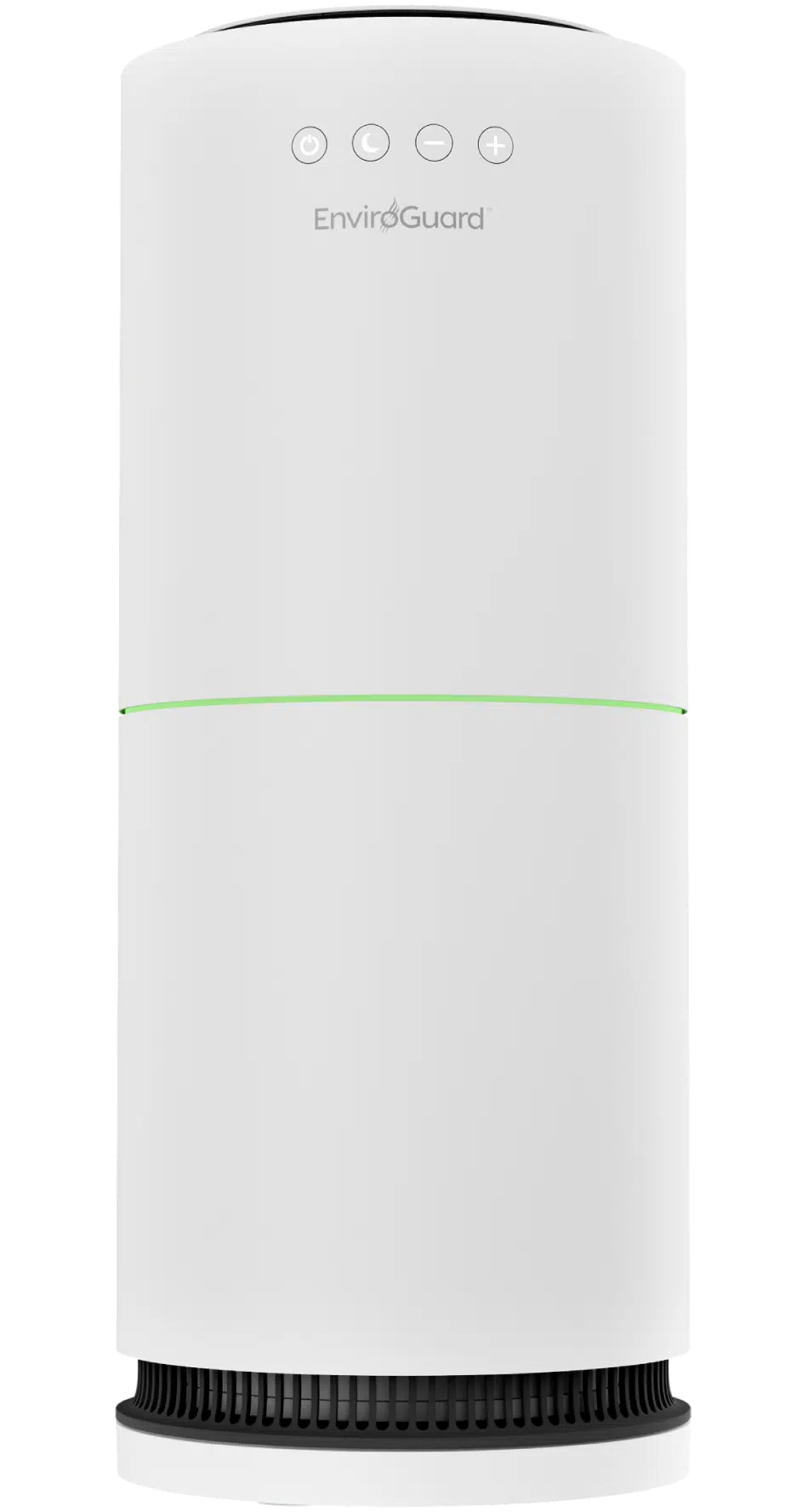
VBreathe brings filtration and active treatment together in one integrated indoor air management system. EnviroGuard PRO X combines PrimeProtect™ four-stage filtration with Purox™ Gel-based Vapour Phase Oxidation, providing two distinct mechanisms within the same device.
PrimeProtect™ Four-Stage Filtration
The PrimeProtect™ system includes:
- Coarse particulate pre-filter: the initial filtration stage for larger particles.
- AerisGuard™ antimicrobial filter: an additional filter layer within the system.
- HEPA-13 filtration: specified by the manufacturer at 99.97% efficiency at 0.3 micrometres under the stated test conditions.
- Activated carbon: intended to help adsorb certain gases and odours.
Purox™ Gel and Vapour Phase Oxidation
Purox™ Gel is a hydrogen-peroxide-based formulation used as part of the system’s VPO approach.
VPO delivers proactive pollution control featuring integrated air filtration to tackle a wide range of pollutants.
Testing Results
- Surface Cleanliness: Averaged 8 RLU across 40+ ATP testing points, zero mold spores or bacteria (0 CFU / raw count) across 20+ surface swabs, and achieved 0 spores/cm² facility-wide by Week 14.
- Indoor Air Quality: Detected <1 mold spore (raw count / CFU) across 25+ air sampling points; conference room airborne mold plummeted from 795 to 4 CFU/m³ using EnviroGuard PRO™ X without traditional HEPA air scrubbers.
- Long-Term Prevention: Completely halted transmission with zero new mold growth recorded from the deployment of EnviroGuard PRO™ X and Purox™ Gel through project completion.
read the full Laboratory Analysis and Case Study Report.
Designed for Everyday Home Use
An air management system needs to fit the way people actually live. Alongside its treatment technologies, EnviroGuard PRO X includes features designed to support everyday operation and maintenance.
Quiet Operation for Living Spaces
EnviroGuard PRO X is specified at 33 dBA at its lowest fan speed. Actual perceived noise depends on the room, background sound, placement and operating setting.
Indoor Air-Quality Monitoring
The system includes integrated air quality sensors for PM1, PM2.5, PM4 and PM10, as well as temperature and humidity monitoring.
Planned Filter and Gel Maintenance
The manufacturer specifies filter replacement approximately every six months under average residential conditions, with actual needs varying according to environmental loading and usage. Purox™ Gel has a separate replacement schedule that also depends on operating conditions.
Airflow and Room Suitability
The product specifications list airflow from 75 to 430 m³/h across the standard settings, with a boost setting up to 500 m³/h.
An Integrated System Rather Than a Single Filter
The distinguishing feature of EnviroGuard PRO X is the combination of PrimeProtect™ filtration and Purox™ Gel-based VPO. Each technology has a different role, allowing the system to be evaluated as a broader indoor air management approach rather than a filter-only design.
Explore the VBreathe EnviroGuard PRO X system.
What Should You Check Before Buying Any Air Purifier?
Whether you are considering VBreathe or another brand, these checks can help you make a more informed decision.
1. Does the Airflow Suit Your Room?
Check the recommended room size, clean air delivery rate (CADR) where available, and the conditions behind the manufacturer’s coverage claim.
As a useful Australian reference, the Victorian Government’s guidance lists a minimum CADR of 300 m³/h for a 25 m² room, based on a 2.4 m ceiling height and up to five people. Its guidance lists 363 m³/h for 30 m² and 432 m³/h for 36 m².
2. What Does the Filtration Claim Actually Mean?
Check the filter classification, the particle size used in the efficiency claim and the test standard.
A percentage stated for a filter under specified conditions should not be treated as the percentage of every pollutant removed from an entire room. Look for information about airflow and whole-system performance where relevant.
3. Does It Address Your Specific Pollutant?
Different concerns require different evidence:
- For dust and smoke particles, look for particle-filtration performance.
- For certain gases and odours, look for evidence relevant to activated carbon or the specific gas-treatment technology.
- For microorganisms, look for test results that identify the organism, method, exposure conditions and measured outcome.
- For mould, address the moisture source and assess any air treatment as part of a broader response.
Be cautious about broad statements such as “removes all pollutants” unless the supporting evidence clearly defines what was tested and what the claim means.
4. What Are the Safety and Intended-Use Requirements?
Before you buy, make sure to read the user manual and safety documentation. An ozone-free rating is valuable, but overall safety depends on how the specific device operates under real-world conditions.
5. What Will It Cost to Maintain?
Calculate the likely ongoing maintenance costs of filters, gels or other consumables. Check their replacement intervals, availability and whether those intervals change with heavy use.
6. Will It Fit Your Daily Routine?
Consider noise, controls, monitoring features, energy use, placement and ease of cleaning. A product’s maximum performance may not be the setting you prefer to use throughout the day or night.
Is EnviroGuard PRO X Right for Your Home?
EnviroGuard PRO X upgrades standard air cleaning into an advanced, dual-action defense system—combining traditional mechanical capture with continuous active treatment.
Why it delivers superior protection:
- Triple-Synergy: Combines medical-grade HEPA-13, activated carbon, and active vapor technology to capture particles and eliminate active contaminants simultaneously.
- Total Threat Coverage: Engineered to conquer complex air quality challenges across particles, odors, VOCs, and microbial growth.
- Real-Time Data Visibility: Continuous digital tracking of PM levels, temperature, and humidity keeps you in full control of your space.
- Predictable Maintenance: Clear consumable tracking ensures peak operating efficiency without unexpected downtime.
- Evidence-Backed Results: Built for clients who require published test data and measurable performance over unsubstantiated claims.
The VBreathe approach combines filtration with active treatment: PrimeProtect™ provides the multi-stage filtration foundation, while Purox™ Gel-based VPO adds a separate treatment mechanism. EnviroGuard PRO X brings these technologies together for households looking to consider a broader approach to indoor air management.
Explore EnviroGuard PRO X, its current specifications and purchasing options.
Take a More Considered Approach to Indoor Air Quality
Choosing an air purifier starts with understanding the problem. Dust, bushfire smoke, odours, VOCs and mould-related concerns do not all require the same response, and no single specification can describe performance against every pollutant.
VBreathe EnviroGuard PRO X brings together PrimeProtect™ four-stage filtration and Purox™ Gel-based Vapour Phase Oxidation in one integrated system. For households looking beyond particle filtration alone, it offers a way to evaluate complementary technologies as part of a broader indoor air management strategy.
Discover VBreathe EnviroGuard PRO X.