How Does an Air Purifier Work? | How to Choose the Right One
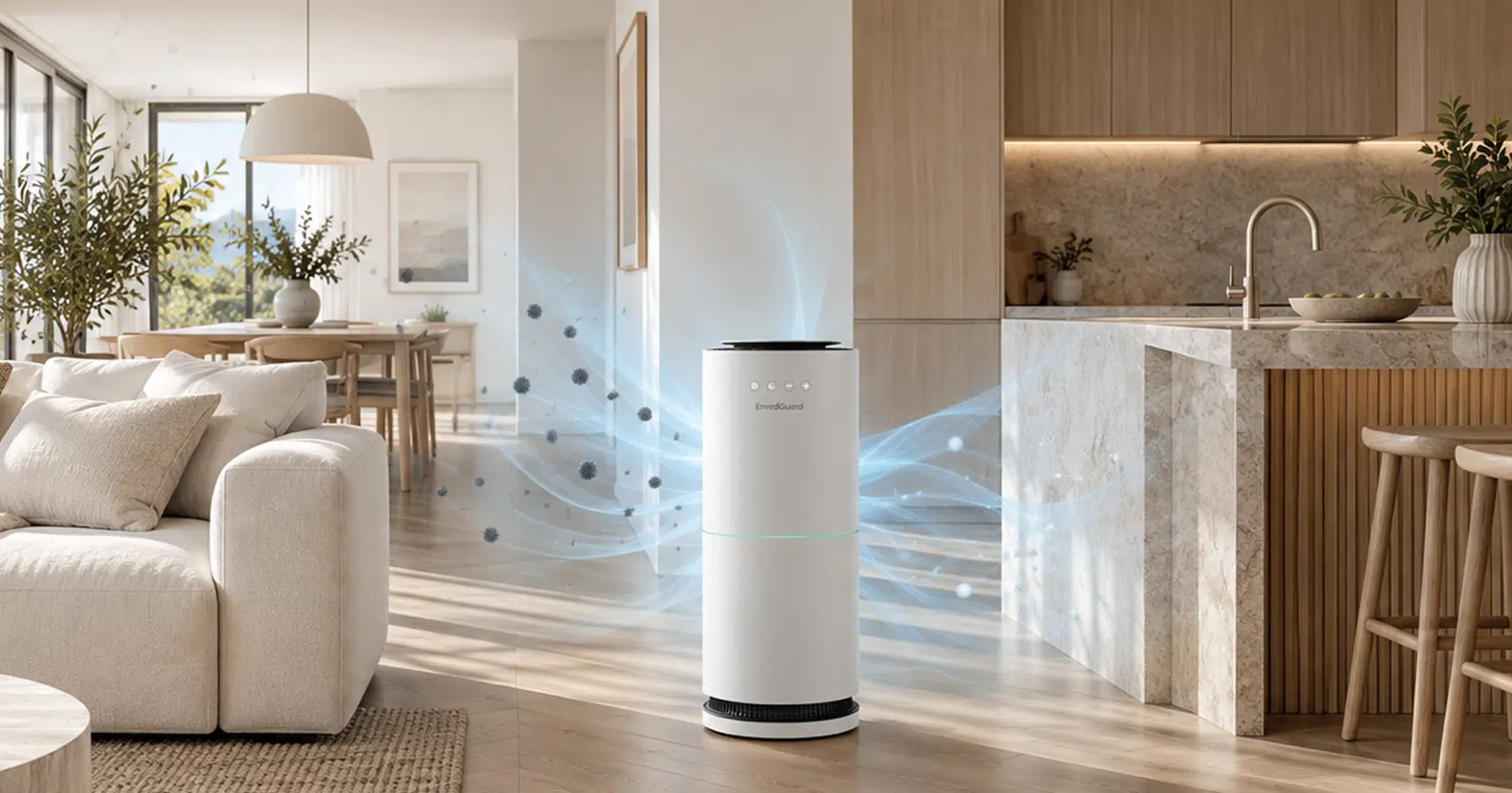
How does an air purifier work? An air purifier draws contaminated indoor air into the unit, where filters or treatment technologies capture, remove or break down pollutants such as PM2.5, pet dander, pollen, mould spores and odours. The treated air is then released back into the room, creating a […]
Air is clean and safe. No health risks expected. Everyone can enjoy outdoor activities without concern.
PM₂.₅
2.48
PM₁₀
3.32
SO₂
2.76
NO₂
8.78
O₃
54.46
CO
118.79
Table of Contents
Share
Today’s Air Quality
London, GB
9:20 AM
Air QualityGood
Air is clean and safe. No health risks expected. Everyone can enjoy outdoor activities without concern.
PM₂.₅
2.48
PM₁₀
3.32
SO₂
2.76
NO₂
8.78
O₃
54.46
CO
118.79
How does an air purifier work?
An air purifier draws contaminated indoor air into the unit, where filters or treatment technologies capture, remove or break down pollutants such as PM2.5, pet dander, pollen, mould spores and odours. The treated air is then released back into the room, creating a continuous air circulation cycle that helps improve indoor air quality.
Traditional purifiers rely mainly on filtration, while advanced systems may combine HEPA filtration with active technologies such as Vapour Phase Oxidation (VPO) to address airborne contaminants and certain pollutants on surrounding surfaces.
If you’ve ever sat in your living room on a sunny afternoon and noticed tiny particles of dust floating through the beam of light coming through the window, you’re not imagining it.
In fact,the air inside your home contains far more than visible household dust. It can also contain pet dander, dust mite allergens, mould spores, pollen, volatile organic compounds (VOCs), formaldehyde and other airborne irritants. However, Even with regular vacuuming, mopping and cleaning, some of the smallest particles can remain suspended in indoor air and circulate through the breathing zone.
This is one reason many people are turning to air purifiers as part of their indoor air quality strategy.
But how does an air purifier actually work?
Does that box simply pull air in and push it back out through a filter? Can it really help reduce the pollutants found inside a home? And how do you know whether a particular air purifier is suitable for your room?
This guide explains the science behind air purification, the technologies used in modern air purifiers, and the key factors to consider when choosing an air purifier for an Australian home.
What You'll Learn From This Guide
Understand the physics of air purification: Learn how an air purifier captures and removes airborne particles and other indoor contaminants.
Go beyond traditional filtration: Understand the difference between conventional HEPA filtration and newer technologies such as Vapour Phase Oxidation (VPO) and Environmental Systems designed to provide broader indoor air treatment.
Choose the right capacity: Learn how CADR and Air Changes per Hour (ACH) can help you match an air purifier to your room size rather than relying solely on marketing claims.
Consider efficiency and safety: Understand energy consumption, ongoing operation and Zero-Ozone considerations when choosing an air purifier for your home.
How Does an Air Purifier Work? How Does It Help Improve Indoor Air Quality?
An air purifier improves indoor air quality by continuously circulating and treating the air within a room.
Specifically, the unit uses a fan to create a pressure difference that draws contaminated indoor air into the system. The air then passes through one or more filtration or treatment stages designed to capture particles, remove pollutants or break down certain contaminants. Finally, treated air is released back into the room, where it mixes with the surrounding air and helps reduce pollutant concentrations over repeated circulation cycles.
This process can be understood as a continuous air circulation and dilution cycle.
Air Purification Process
Contaminated Air
Dust, mould spores, pet dander, pollen, VOCs and airborne particles.
Inside The Purifier
Air Intake
Fan draws room air into the unit.
Treatment & Filtration
Pre-filter: captures hair & larger dust
Main filter: captures fine particles
Active treatment: breaks down pollutants
Clean Air Delivery
Pushes treated air back into the environment.
Treated Air
Clean, treated air circulates through the room to improve the Breathing Zone.
Indoor pollutants are not limited to the dust we can see. Homes can also contain a mixture of allergens, irritants, gases and microorganisms that may remain airborne or accumulate on surfaces.
Common Indoor Air Pollutants
Dust Mites: Dust mites and their waste products are common indoor allergens, particularly in bedding, carpets, upholstered furniture and other textiles. Allergenic particles can become airborne when these surfaces are disturbed.
Mould: Mould spores can become airborne and are commonly associated with damp or poorly ventilated areas such as bathrooms, walls, carpets and other moisture-prone spaces. When disturbed, spores can become suspended in indoor air.
Pet Dander: Small particles of skin, saliva and proteins associated with animals can become airborne and settle on surfaces throughout the home. These allergens may accumulate on sofas, carpets, bedding and other frequently used areas.
Pollen: Outdoor pollen can enter the home through doors, windows, clothing and footwear. It can settle on indoor surfaces and become airborne again through movement, cleaning or everyday household activity.
Volatile Organic Compounds (VOCs): VOCs can be released from paints, furniture, building materials, cleaning products, fragrances and many other household products. Because VOCs are gases, they cannot be seen and may remain present in indoor air even when the room appears clean.
Germs and Microorganisms: Bacteria, viruses and other microorganisms can be associated with airborne droplets and particles or settle on frequently touched surfaces such as door handles, tables, furniture and household items.
In fact, these pollutants can be difficult to identify because many are invisible. Depending on the pollutant and the technology being used, an air purifier may help capture airborne particles, reduce certain pollutants or provide additional treatment of the indoor environment.
The 3-Step Air Purification Cycle
Most air purification systems can be understood through three basic stages: Air Intake, Treatment & Filtration, and Clean Air Delivery.
1. Air Intake
The internal motor and fan create airflow that draws surrounding room air into the air purifier.
The incoming air may first pass through a pre-filter, which captures larger particles such as hair, visible dust and other debris. As a result, this helps prevent larger contaminants from reaching and prematurely loading the finer filtration stages.
2. Treatment & Filtration
Once larger particles have been removed, the air moves through the main treatment system.
In a conventional air purifier, this stage typically relies on a dense filter media designed to capture fine airborne particles. A HEPA filter, for example, is designed to capture very small particulate matter as air passes through the filter.
Furthermore, more advanced air purification systems may combine particle filtration with additional treatment technologies. Depending on the system, this can include technologies designed to address gases, odours or other contaminants that conventional particle filtration alone may not fully address.
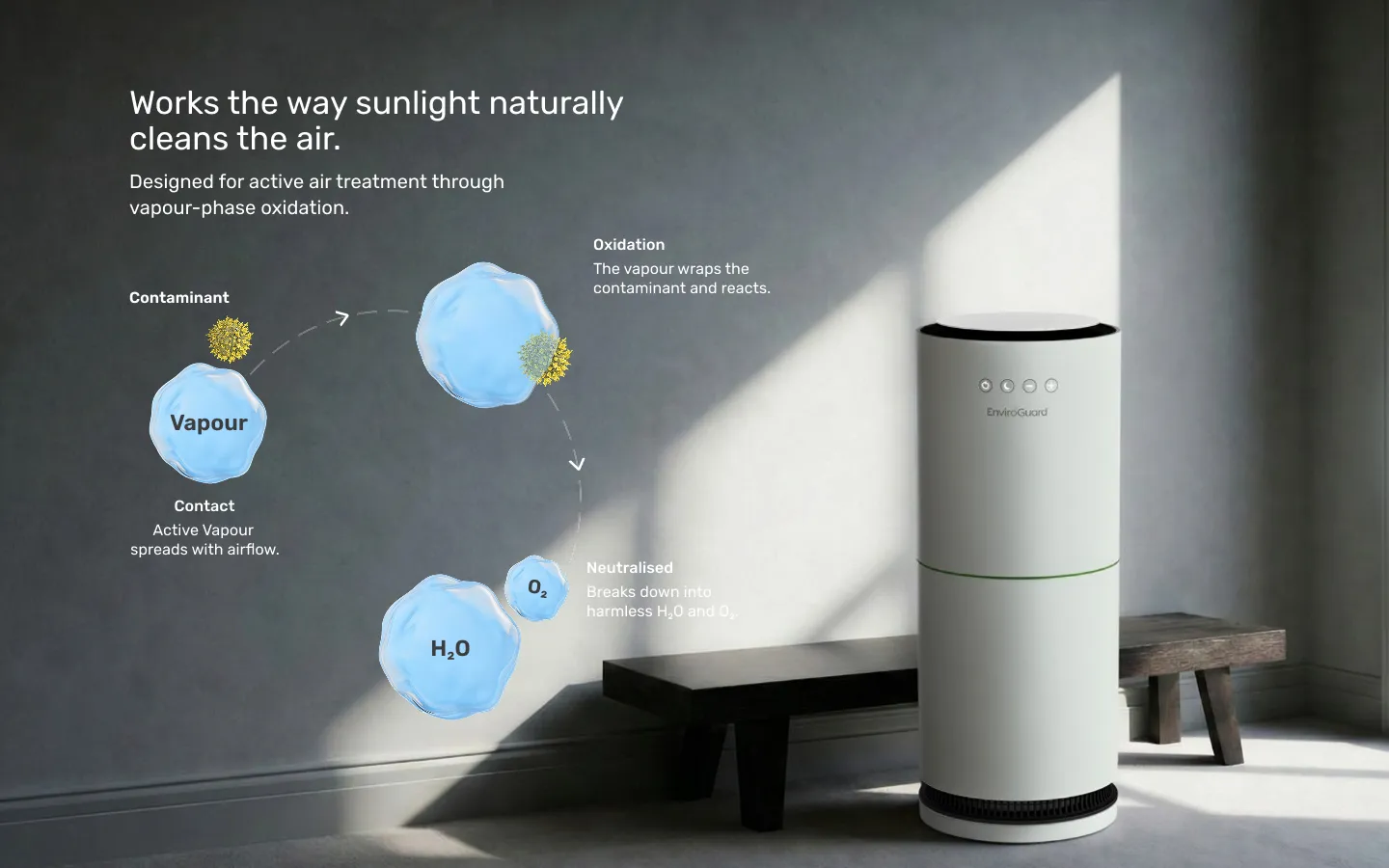
One example is Vapour Phase Oxidation (VPO), an active air treatment technology designed to distribute a treatment agent through the environment rather than relying solely on contaminated air reaching a passive filter.
3. Clean Air Delivery & Circulation
After treatment, the air is pushed back into the room through the air outlet.
The resulting airflow mixes with the surrounding room air, creating continuous circulation. As the process repeats, more of the room’s air passes through the purification system.
This is why factors such as CADR, airflow rate, room volume and Air Changes per Hour (ACH) are important when assessing how effectively an air purifier can treat a particular space.
Understanding the Difference Between Filtration and Active Air Treatment
Traditional air purifiers primarily work by bringing contaminants to the filter.
Although this is highly useful for airborne particles, but filtration has a fundamental limitation: the pollutant generally needs to enter the airflow and physically reach the filter before it can be captured.
This is where active treatment technologies take a different approach.
Rather than relying exclusively on airflow to bring contaminants to a filter, an active treatment system can introduce a treatment process into the surrounding environment.
Vapour Phase Oxidation (VPO) is one example. It uses a controlled vapour-phase treatment to interact with selected contaminants in the air and environment. When combined with particle filtration, this creates a dual approach: filtration for airborne particles and active treatment for pollutants that may not be effectively addressed by filtration alone.
The exact capabilities depend on the technology, concentration, operating conditions and specific air purifier design.
The Limitation of Conventional Airflow: Dead Air Zones
Air purification depends not only on the filter inside the machine, but also on how effectively air moves throughout the room.
A conventional air purifier relies on its fan to draw surrounding air towards the intake. As the distance from the unit increases, airflow can become less direct, particularly in rooms with furniture, walls, corners and other obstacles.
Consequently, areas with limited air movement are sometimes described as dead air zones.
For example, air around corners, underneath furniture or behind large objects may circulate more slowly than air immediately surrounding the purifier. Pollutants deposited on carpets, upholstery, curtains or bedding may also remain on those surfaces rather than being immediately drawn into the air purifier.
This is an important distinction when evaluating air purification technology:
A filter can only capture airborne contaminants that actually reach the filter.
Good room placement, appropriate airflow and sufficient circulation remain important factors in achieving effective air purification.
For this reason, simply choosing a purifier with a high headline filtration efficiency does not necessarily tell the whole story. Room size, CADR, airflow distribution, operating speed, ACH and the type of pollutants you want to address all matter when selecting an air purifier.
Comparing Air Purification Technologies: How Does HEPA Differ from Vapour Phase Oxidation?
The key difference between these technologies is how they interact with indoor pollutants.
Conventional filtration systems such as Mechanical HEPA and Activated Carbon primarily rely on contaminated air being drawn into the air purifier, where particles or gases are captured by the filter media.
By contrast, Vapour Phase Oxidation (VPO) is an Active Environmental System that uses a controlled vapour-phase treatment to interact with selected contaminants in the air and surrounding environment.
Understanding this difference is important when choosing an air purifier because no single technology is designed to address every type of indoor pollutant in exactly the same way.
Let’s look at how the major air purification technologies work and where each one fits within a modern indoor air quality system.
1. Mechanical True HEPA Filter
How it works: A True HEPA filter uses a dense network of fine fibres to capture airborne particles as air passes through the filter. Particle capture occurs through several physical mechanisms, including impaction, interception and diffusion.
Key strengths: True HEPA filtration is highly effective at capturing fine airborne particles, including dust, dust mite allergens, pet dander, pollen and mould spores. By removing these particles from the airflow, HEPA filtration can help reduce the concentration of airborne particulate matter and allergens within a room.
Important limitation: HEPA is primarily a particle filtration technology. Therefore, it is not designed to remove gases or VOCs directly.
However, HEPA filtration also captures microorganisms within the filter media, but capture does not necessarily mean immediate inactivation or destruction. If odours, VOCs or certain microorganisms are a key concern, additional technologies such as Activated Carbon or Active Air Treatment may be used alongside HEPA filtration.
2. Activated Carbon Filter
How it works: Activated Carbon contains a highly porous structure with a large surface area. It uses adsorption to hold certain gas molecules and compounds on the surface of the carbon as air passes through the filter.
Key strengths: Activated Carbon can help reduce odours and certain VOCs from sources such as cooking, household products, cleaning products, paints, furniture and other chemical emissions. It therefore complements HEPA filtration, which is primarily focused on airborne particles such as dust, dust mite allergens, pet dander, pollen and mould spores.
Important limitation: Activated Carbon performance depends heavily on the amount and type of carbon, the properties and concentration of the target gas, airflow and contact time.
Carbon also has a finite adsorption capacity. As adsorption sites become occupied, its ability to capture additional compounds can decrease. Regular filter replacement is therefore important and should be based on the manufacturer’s recommendations and the conditions in which the purifier operates.
3. Ioniser and Plasma Systems
How they work: Ionisers and some plasma-based systems use electrical fields or electrical discharge to give airborne particles an electrical charge. Charged particles may then attract one another, settle onto surfaces or be captured by a collection plate or filter designed to work with the system.
Key strengths: Depending on the system design, ionisation can help reduce airborne particles such as dust, pollen, pet dander and other suspended particulate matter.
Important limitations: Ionisation does not directly address every type of indoor pollutant. In addition, causing particles to settle onto surfaces does not necessarily mean that the pollutants have been removed from the environment.
Some ionisation and plasma technologies may also produce ozone (O₃) as a by-product, depending on their design and operating conditions.
For people looking for an air purifier for enclosed indoor spaces, ozone-free operation or independently verified low-ozone performance can therefore be an important consideration when comparing technologies.
How it works: Vapour Phase Oxidation (VPO) is an Active Air Treatment approach that does not rely solely on drawing contaminated air through a passive filter. Instead, a controlled vapour-phase treatment is dispersed through the indoor environment, allowing it to interact with selected contaminants in the air and on accessible surfaces.
Key Advantages of an Active Environmental System
1. Designed to address more than airborne particles
An Active Treatment system can work alongside HEPA filtration to address different categories of indoor pollutants.
HEPA filtration focuses on airborne particles such as:
Dust
Dust mite allergens
Pet dander
Pollen
Mould spores
An active treatment process may provide an additional mechanism for addressing odours and certain chemical compounds, including selected VOCs, depending on the technology and operating conditions.
This creates a more comprehensive approach than relying on particle filtration alone.
2. Extends treatment beyond the filter pathway
A conventional filter can only capture contaminants that are carried into the unit by airflow.
In contrast, a vapour-phase treatment is distributed from the system into the surrounding environment. This means the treatment process is not limited exclusively to air that passes directly through the filter.
Depending on the technology, operating conditions and exposure time, this may allow treatment to interact with selected contaminants present in areas such as carpets, upholstered furniture, bedding and other accessible indoor surfaces.
3. Provides an additional approach to odours and VOCs
Activated Carbon primarily works through adsorption, holding certain gas molecules on the surface of the carbon.
Oxidation-based treatment works differently. Selected compounds can undergo a chemical reaction that changes their molecular structure.
The effectiveness of this process depends on factors including the type and concentration of the contaminant, treatment concentration, contact time, airflow and system design.
As a result, VPO should be viewed as a complementary treatment mechanism rather than a universal replacement for mechanical filtration.
4. Designed as part of an indoor environmental treatment system
For residential applications, controlling treatment levels and managing potential by-products are important considerations.
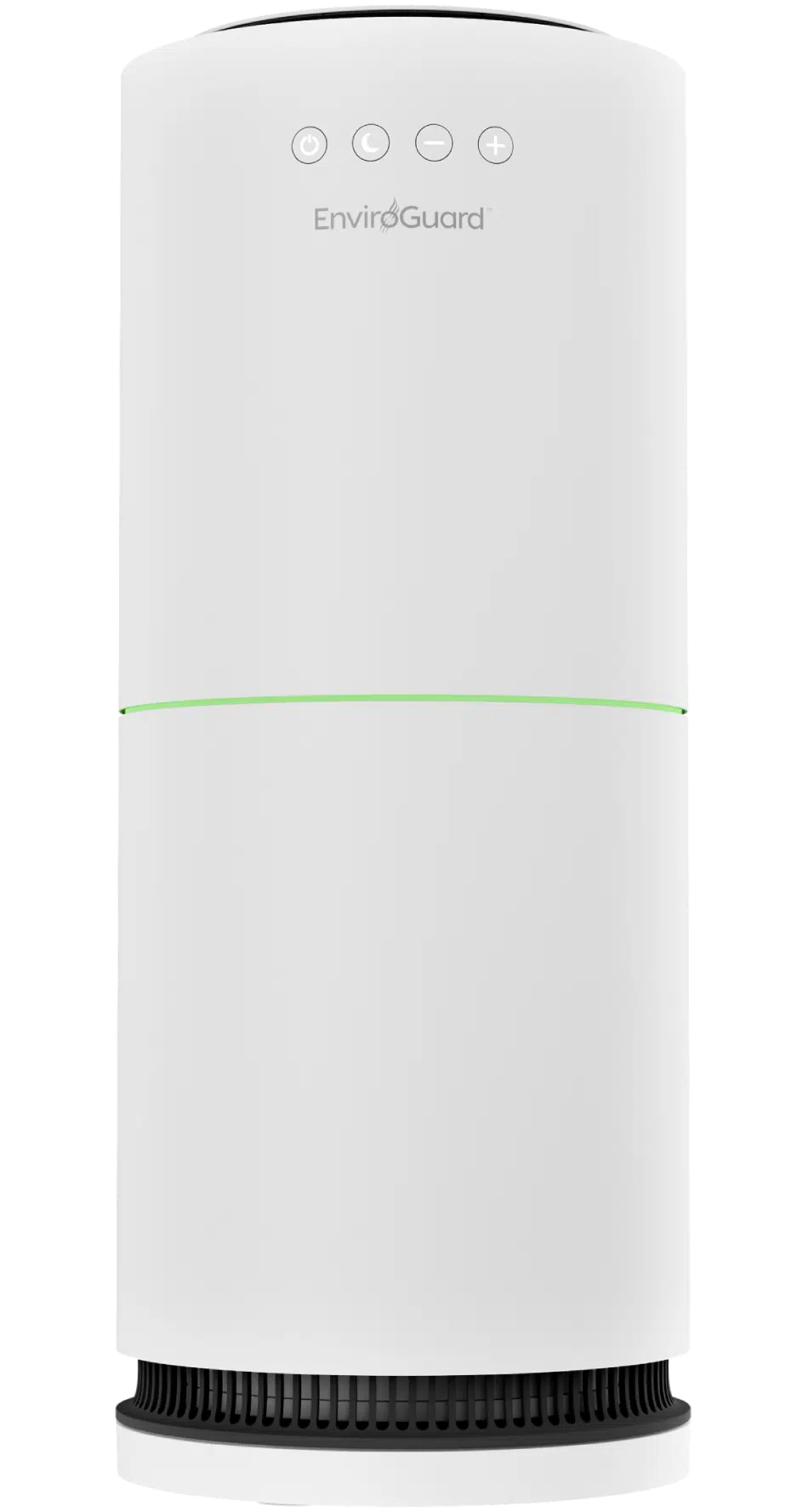
The EnviroGuard PRO™ X combines Active Vapour Technology with HEPA-13 filtration to provide two complementary treatment mechanisms within one system.
Its active vapour system is designed without using ozone as the primary oxidising agent, while the HEPA-13 filtration stage provides mechanical filtration of airborne particles.
Air Purification Technology Comparison
Feature / Capability
Mechanical True HEPA
Activated Carbon
Ioniser / Plasma
Complete System
Vapour Phase Oxidation (Environmental System)
Primary mechanism
Passive mechanical filtration
Passive adsorption
Active particle charging
Active environmental treatment
Dust / pet hair / pet dander / pollen
Effective particle capture
Not applicable
Depends on system design
Used alongside HEPA filtration
Dust mite allergens / mould spores
Captures airborne particles
Not applicable
Depends on system design
Used alongside filtration and active treatment
Odours and VOCs
Limited
Adsorbs certain compounds
Not the primary function
Can react with selected compounds
Airborne bacteria & microorganisms
Can capture particles (but capture does not mean inactivation)
Not the primary function
Depends on technology and design
Active treatment may interact with selected contaminants
Treatment of accessible surfaces
Primarily limited to air passing through the unit
Primarily limited to air passing through the carbon media
Depends on system design
Vapour-phase treatment can extend into the surrounding environment
Contaminants away from the unit
Dependent on room airflow and circulation
Dependent on room airflow and circulation
Dependent on ion distribution
Designed for distribution throughout the treated environment
Multi-pollutant approach
Primarily particles
Primarily gases and odours
Primarily particles
Combines active treatment with mechanical filtration
Pollutant accumulation in media
Yes — particles accumulate on the filter
Yes — selected compounds are adsorbed by carbon
Depends on system
Active treatment can chemically transform selected compounds
Ozone considerations
Not the primary mechanism
Not the primary mechanism
Depends on system design
EnviroGuard PRO™ X does not use ozone as its primary oxidising agent
Role in EnviroGuard PRO™ X
HEPA-13 filtration
Carbon filtration
Active Vapour Technology + Environmental Treatment
Choosing the Right Air Purification Technology
There is no single filtration technology that performs every function equally well.
Therefore, when comparing air purifiers, consider the type of pollutants you want to address:
Dust, pollen and airborne allergens: Look for effective mechanical filtration, particularly a properly specified HEPA system.
Odours and certain VOCs: Consider an air purifier with an appropriately sized Activated Carbon stage or another technology designed to address gases.
Particles and allergens throughout a room: Consider the purifier’s CADR, airflow and ACH, not just the filter specification.
Broader environmental treatment: Systems combining mechanical filtration with Active Air Treatment may provide an additional treatment pathway beyond conventional filtration.
Indoor safety: Check the manufacturer’s information regarding ozone emissions, treatment levels and applicable safety standards.
Whole-room performance: Consider how the system circulates and treats air throughout the room rather than evaluating the filter in isolation.
The Australian Context: Why Local Conditions Can Demand More Than Standard Air Filtration
Australia’s environment presents a unique set of Indoor Air Quality (IAQ) challenges. Specifically, these conditions can mean that a conventional filter-based air purifier may not address every type of airborne pollutant that can affect the indoor environment of Australian homes and the people and pets living in them.
For a healthier indoor environment, choosing an air purifier in Australia means considering three important environmental factors:
Bushfire Smoke & PM2.5:
Bushfire smoke contains more than fine PM2.5 particles, which can be captured by HEPA filtration. In addition, it can also contain gaseous pollutants and volatile organic compounds (VOCs), including compounds such as benzene and formaldehyde, generated during the combustion of vegetation and other materials. Addressing these pollutants may require additional gas-phase treatment alongside particle filtration. (Read more:How to Manage Indoor Air Quality During a Bushfire)
Coastal Humidity & Mould Spores:
In coastal states such as New South Wales and Queensland, periods of high humidity and wet weather can create conditions that support mould growth in poorly ventilated areas, including around walls and other damp surfaces. A conventional air purifier can capture airborne mould spores that pass through the unit, while technologies such as Vapour Phase Oxidation are designed to disperse an active vapour throughout the environment and provide treatment beyond the immediate filter airflow path. (Explore the issue in more detail:Air Purifiers for Mould Spores in the Home)
Seasonal Pollen & Hay Fever:
Seasonal pollen is a significant consideration for people affected by hay fever and pollen allergies across Australia. In particular, Ryegrass Pollen is an important seasonal allergen in parts of Victoria and other southern regions. When choosing an air purifier for allergy management, factors such as a sufficiently high Air Changes per Hour (ACH) and recognised programmes or certifications such as Sensitive Choice may be relevant considerations for people looking to reduce airborne allergen exposure. (Learn more:How to Manage Indoor Air Quality for Allergies and Hay Fever)
How to Calculate Room Size, CADR and Air Changes per Hour (ACH) for Australian Homes and Pet Owners
Choosing the right air purifier size should not be based solely on the “Maximum Room Size” stated on the product packaging. Instead, you should calculate the required Clean Air Delivery Rate (CADR) based on the actual volume of the room. For a typical home, an air exchange rate of at least 2 to 3 Air Changes per Hour (ACH) is generally recommended. Homes with pets or people with allergies may require a higher air circulation rate of around 4 to 5 ACH to help keep up with the continuous release of pet dander, fur and other airborne allergens.
What Are CADR and ACH?
CADR (Clean Air Delivery Rate): This refers to the volume of clean air an air purifier can deliver within a given period of time. It is commonly expressed in cubic metres per hour (m³/h) or cubic feet per minute (CFM). In general, the higher the CADR, the faster an air purifier can clean the air and the greater the room volume it can effectively support.
ACH (Air Changes per Hour): This refers to how many times an air purifier can process an amount of air equivalent to the entire room volume within one hour. A higher ACH means air is circulated through the air purifier more frequently.
CADR Requirement Calculator
m²
m
Required CADR for Breathing Zone
---
m³/h (Cubic Meters/Hour)
Equivalent Required CADR (CFM)
---
CFM (Cubic Feet/Minute)
What you need to know about this calculation:
The Formula: The required CADR (m³/h) is calculated as: Room Area (m²) × Ceiling Height (m) × Required ACH (times/hour).
Why ACH Matters: ACH (Air Changes per Hour) represents how many times the purifier cleans the entire room's air volume in one hour. A Standard Room needs at least 2.5 ACH. However, homes with pets or high allergen loads require a much higher rate, like 4.8 ACH, for effective environmental management.
How to Use These Numbers: When choosing an air purifier, look for a product with a CADR rating (for Dust/Pollen) that is equal to or higher than the result shown above.
Quick Reference Table: Room Size vs Required CADR
The following table is calculated using a standard ceiling height of 2.6 metres, making it easier to compare your room size with the specifications of different air purifiers.
Room Area
Volume
Suitable Room Type
Typical Home (2.5 ACH)
Pets / Allergies
High Allergen Load (4.8 ACH)
15 m²
39 m³
Small bedroom, home office
98 m³/h(58 CFM)
187 m³/h(110 CFM)
25 m²
65 m³
Large bedroom, studio apartment
163 m³/h(96 CFM)
312 m³/h(184 CFM)
35 m²
91 m³
Medium-sized living room, one-bedroom apartment
228 m³/h(134 CFM)
437 m³/h(257 CFM)
50 m²
130 m³
Open-plan living area, combined living and kitchen space
325 m³/h(191 CFM)
624 m³/h(367 CFM)
Important Air Purification Consideration
If your home has a large open-plan layout, such as a living area connected to a cat litter area or a dog's sleeping space, relying on a single large air purifier may not always provide even air circulation across every zone. An air purifier used alongside Vapour Phase Oxidation can provide an additional approach to environmental treatment, as the active vapour is designed to disperse through the environment rather than relying solely on the fan's airflow to draw contaminants towards a filter.
Quick FAQ: 6 Common Questions
Can an air purifier really help reduce pet odours?
Yes, but HEPA filtration alone will not remove gaseous odours.
For odours from cat litter, urine or other pet waste, look for Activated Carbon or an active treatment technology such as Vapour Phase Oxidation that can address odorous compounds beyond the filter airflow path.
Do air purifiers produce oxygen?
No. Air purifiers do not produce oxygen or remove CO2.
They clean or treat pollutants already present in the air. If a room remains closed for long periods, use appropriate ventilation to introduce fresh outdoor air rather than relying on an air purifier to improve oxygen or CO2 levels.
Can an air purifier really help with allergies?
Yes. A HEPA air purifier can help reduce airborne allergens such as dust, pollen, pet dander and mould spores.
However, allergens can also settle on bedding, carpets and furniture, so air purification should be combined with regular cleaning and source control.
Can an air purifier help with asthma?
It may help reduce exposure to some airborne asthma triggers, but it does not treat or cure asthma.
Reducing airborne particles such as dust, pollen and pet dander may help limit environmental exposure. An air purifier should not replace prescribed asthma treatment or medication.
Does capturing microorganisms on a filter mean they have been killed?
No. Capturing a microorganism does not necessarily mean it has been killed or inactivated.
HEPA filtration primarily traps particles within the filter media. If microbial inactivation is an important requirement, consider systems that combine particle filtration with an additional active treatment mechanism.
Will an air purifier dry out human or pet skin?
No. A standard air purifier does not normally reduce indoor humidity or dry out skin.
Dry air at night is more commonly associated with air conditioning or low indoor humidity. An air purifier only acts as a dehumidifier if it specifically includes a dehumidification function.
Summary 5-Point Air Purifier Checklist
01
Match CADR to Your Room
DO: Calculate room volume and check whether the CADR can deliver around 4–5 ACH for continuous particle filtration.
DON’T: Rely solely on the manufacturer's stated Coverage Area.
Quick check: 25 m² × 2.4 m = 60 m³ → 4.8 ACH requires approximately 288 m³/h CADR.
02
Match the Technology to the Pollutant
DO: Check whether the system addresses the pollutants you actually need to manage — particles, allergens, odours or VOCs.
DON’T: Assume HEPA alone can remove gases or odours. Look for Activated Carbon or an independently evaluated active treatment technology where appropriate.
03
Verify Ozone and Safety
DO: Check verified ozone-emission data, the substances used and any by-products generated during operation.
DON’T: Rely solely on an “Ozone-Free” marketing statement, especially for continuous use around children and pets.
04
Check Real-World Noise
DO: Compare Sleep Mode and everyday operating dBA, not just the lowest advertised noise level.
DON’T: Choose based only on the quietest setting if you need the purifier to operate at higher fan speeds for extended periods.
05
Calculate Total Cost of Ownership
DO: Compare the 3–5 year cost of filters, treatment cartridges, electricity and maintenance.
DON’T: Compare only the upfront purchase price.
Check:
Pre-filter cleaning and lifespan
HEPA and Carbon filter replacement
Treatment cartridge replacement
Replacement intervals
Energy consumption
Ongoing maintenance
Key Takeaway
Choose an air purifier based on the pollutants you need to manage — not a single specification.
Check CADR/ACH, pollutant-specific technology, ozone emissions, real-world noise and 3–5 year ownership costs before comparing products.
HEPA captures particles; Activated Carbon adsorbs certain gases and odours; active treatment technologies such as Vapour Phase Oxidation provide an additional mechanism for addressing certain contaminants.
Limited-Time Offer
Transform Your Indoor Air Quality
Upgrade to the innovative EnviroGuard PRO™ X today for only $790 (Was $1,590). Claim your $800 saving now and breathe cleaner, healthier air tomorrow.
How to Get Rid of Dust in Your Bedroom Quick answer: To reduce dust in your bedroom, deal with two things at the same time: dust that settles on surfaces and fine particles that remain in the air. Wipe furniture with a slightly damp microfibre cloth, wash your bedding […]
Air purifiers genuinely help alleviate airborne allergies and Hay Fever by reducing the concentration of allergens in the air, such as pollen, dust mites, and pet dander. They achieve this by capturing over 99.97% of particles as small as 0.3 microns through a True HEPA filter. However, modern Environmental […]
How does an air purifier work? An air purifier draws contaminated indoor air into the unit, where filters or treatment technologies capture, remove or break down pollutants such as PM2.5, pet dander, pollen, mould spores and odours. The treated air is then released back into the room, creating a […]
How Do You Destruct VOCs? Most standard air purifiers fail to eliminate Volatile Organic Compounds (VOCs) because they rely on passive filtration (like HEPA), which only captures solid particles, or thin activated carbon filters that quickly saturate and risk releasing trapped toxic gases back into your room. For definitive […]
Many people experience no allergy issues with their first dog or cat. However, introducing a second or third pet into the home often triggers sudden sneezing, nasal congestion, red eyes, itchy skin, or morning chest tightness. This sudden reaction does not mean you have “developed a pet allergy out […]
¹ Tested in independent Australian laboratories under controlled conditions using airborne mould spores, bacteria and allergen particulates (0.3μm–10μm).
² Based on third-party testing results confirming 99.9% reduction in airborne mould spores and pet dander when using EnviroGuard Pro X with Purox™ Gel over 24 hours.
³ Independent testing by ICAS Testing Technology Service (Shanghai) Co., Ltd. demonstrated 99.99% reduction in airborne Staphylococcus Albus bacteria within 30 minutes in a 20m² test chamber, in accordance with Technical Standard for Disinfection GB 27948-2020.
⁴ Surface efficacy testing conducted by Eurofins BioPharma Product Testing — Sydney (Eurofins ams Laboratories Pty Ltd, TGA-licensed under MI-2021-LI-08995-1). Reductions over 8 hours: 99.99% Pseudomonas Aeruginosa, 99.9% Escherichia Coli, 90% Candida Albicans Yeast.
⁵ "10x faster than conventional filtration" comparison based on EnviroGuard Pro X achieving log 4 (99.99%) airborne bacterial reduction in 30 minutes, compared with log 1 (90%) pathogen reduction in 20 minutes reported for hospital HEPA systems operating at 12 air changes per hour (Fernstrom A, Goldblatt M. Aerobiology and its role in the transmission of infectious diseases. J Pathog. 2013;2013:493960).
⁶ Performance varies based on room size, airflow configuration, fan speed setting, environmental conditions and usage patterns.